
A car does not only carry people and cargo, it carries the energy of an entire era. Look into the fuel tank, into the carburetor, into the charging port, and you see a whole nation that has passed through countless turns just to keep its wheels spinning steadily. This is not the story of a machine alone, but of a whole country searching for its own path to energy independence, from the imported drops of gasoline in the French colonial days to the electric current flowing from Vietnam’s very first battery plant.
Part 1: The Pearl of the Far East Shines on Gasoline, and the Charcoal Buses
Before 1975, Saigon was a living portrait of the European car world. Along tree lined boulevards, the Peugeot 203 and 403 glided by with quiet pride, next to the petite Renault 4CV and the Citroën 2CV, whose soft curved body looked like a piece of sculpture in motion. There was Fiat from Italy too, and Ford from America.
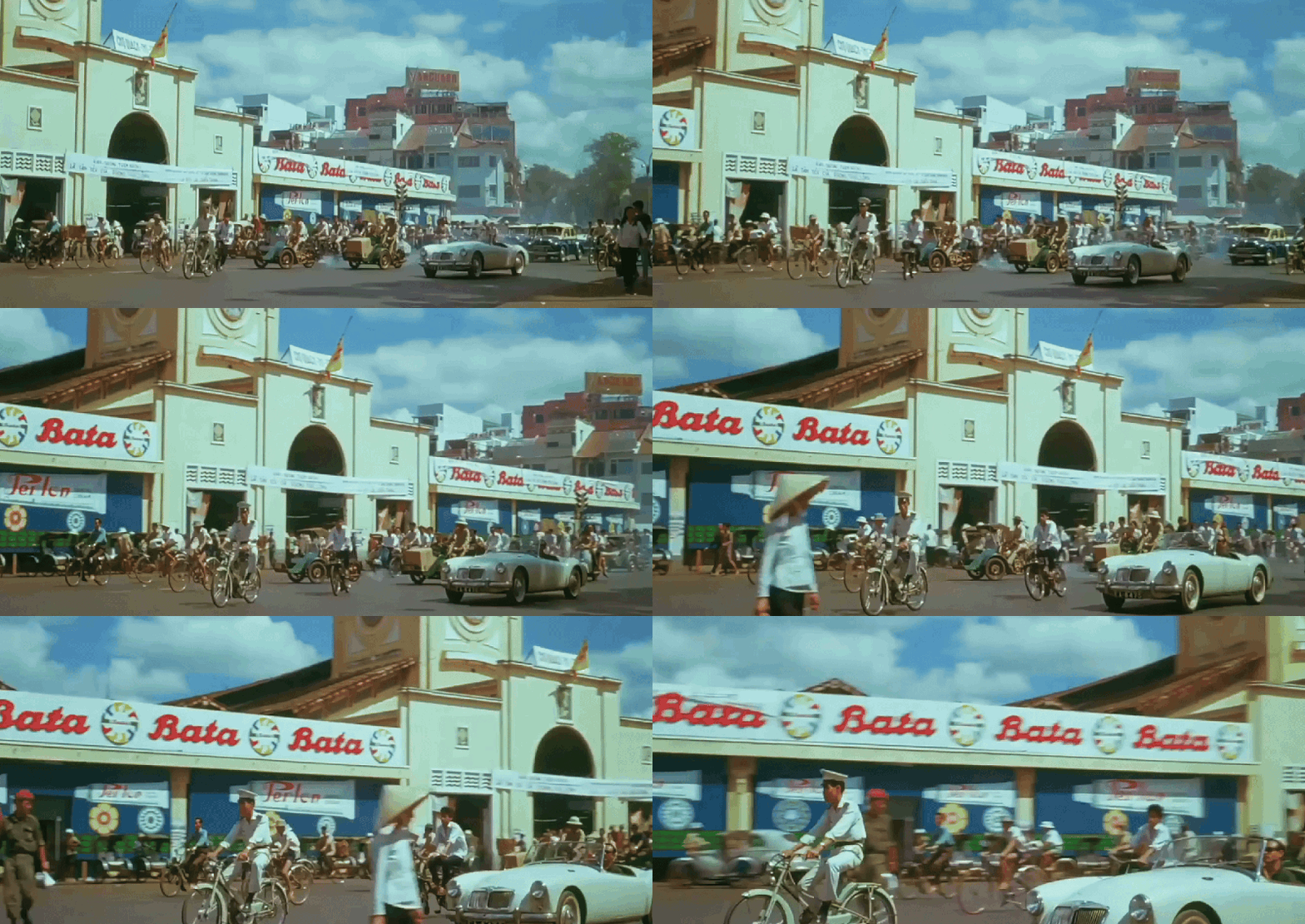
All of them ran on internal combustion engines, engines that knew only one source of life: gasoline and oil. The Pearl of the Far East did not shine only through neon lights, but through the crisp crackle of imported engines, a symbol of prosperity and wide open trade.
But history did not allow that brilliance to last in the old way. After 1975, the country entered the subsidized economy period, and gasoline, the very lifeblood every car needed, became a strategic commodity placed under strict state control. Filling a tank was no longer something simple and easy; fuel was rationed through coupons, and long lines of people formed in front of the pumps.
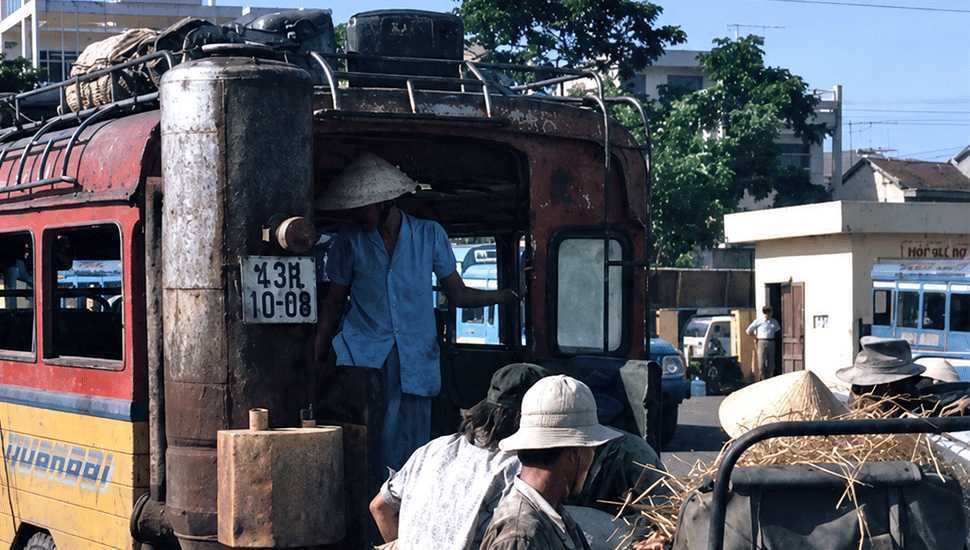
In that context, the intercity buses, the arteries of transportation linking region to region, could not simply wait. People were forced to rebuild the whole engine system, turning machines that were born to drink gasoline into machines that could chew on coal instead.
The operating principle sounds almost far fetched, yet it was thoroughly practical: coal was burned inside a large tank mounted at the rear or on the side of the vehicle, and the heat generated by that combustion was carried through a system of pipes to produce gas, mainly flammable carbon monoxide. That stream of gas was fed into the carburetor in place of gasoline vapor, mixing with air before entering the engine’s combustion chamber.
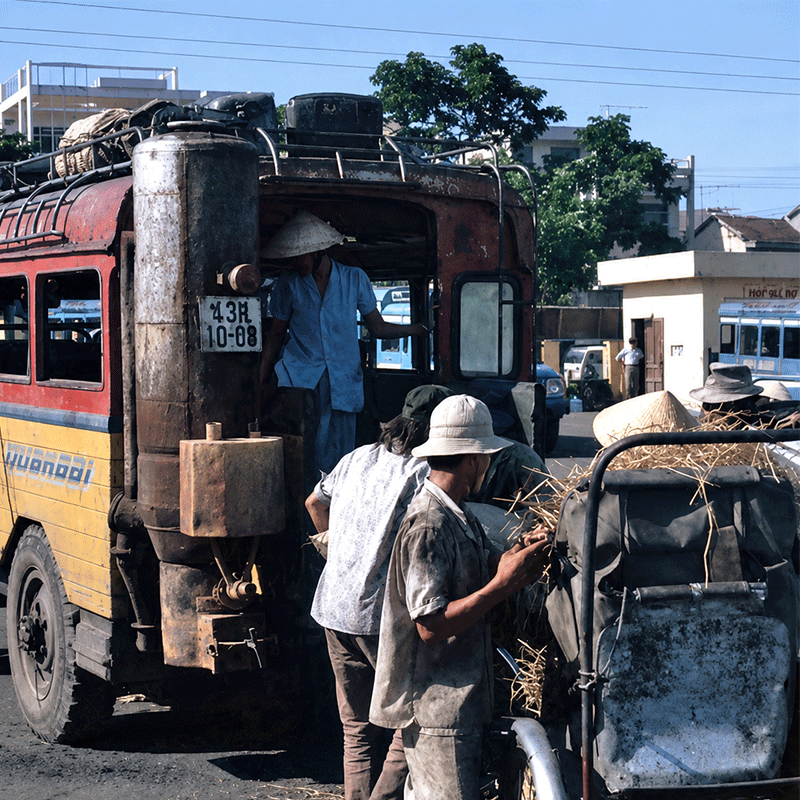
There was no electric motor, no battery, no gas station or charging point, only fire, smoke, and the survival ingenuity of the Vietnamese people in a time of the most extreme scarcity.
Every bus journey back then was a genuine struggle: the vehicle had to stop midway to shovel in more coal, black smoke billowed thick behind it, top speed rarely exceeded thirty kilometers an hour, yet the destination still had to be reached. It was a tragic and heroic chapter in the history of Vietnamese transportation, a time when liquid fossil fuel was scarce and people turned back to the most primitive solid fossil fuel of all.
It was not until the Reform year of 1986 that the door to gasoline opened wider. Fuel returned in full supply at the pumps, and filling the tanks of a BMW 3 Series, a Toyota Corolla, or a Mazda 626 was no longer a privilege reserved for the few.
The green land of Vietnam, after a decade of straining through coal smoke, could finally breathe again through the vapor of gasoline and the scent of oil.
Part 2: The Embargo Is Lifted, and the Great Names of the Auto World Answer the Roll Call
1994 was a pivotal milestone when the United States officially lifted its trade embargo against Vietnam, the door to global integration swung open, and international automakers began looking at this emerging market with hopeful eyes. Toyota, Mitsubishi, and BMW arrived. Ford, a name that had once shone brightly before 1975, also returned…
This was the period when Vietnam’s automotive industry transformed itself, moving away from simple assembly work and beginning to access the modern internal combustion engine technology of the world. Joint venture factories rose up, CKD assembly lines took shape, and Vietnamese people started gaining access to internationally standard gasoline powered cars right on their own soil. Those two pivotal decades laid the foundation for an even bigger dream ahead: the dream of a car that would carry the Vietnamese name itself.
Part 3: VinFast Is Born, and the Spectacular Pivot from Gasoline to Pure Electric
In 2017, VinFast was born, and a dream that once seemed distant for the domestic auto industry began taking real shape. In an almost unbelievably short time, the first two gasoline models bearing the words “Made in Vietnam,” the LUX A2.0 Sedan and the LUX SA2.0 SUV, rolled off the assembly line in Hai Phong. It was the moment when an entire nation, long accustomed to seeing cars only as imported goods, saw its own name engraved on the hood of a gorgeous near luxury sedan for the very first time.
VinFast, the flag bearer, did not stop there…
Seeing the global wave of electrification rising higher and higher, VinFast arrived at a turning point decision: to pivot completely away from the internal combustion engine and toward pure electric vehicles, the BEV, or Battery Electric Vehicle.
From the VF e34, VF8, and VF9 to the more accessible lineup of VF3, VF5, VF6, and VF7, VinFast walked a path that not many young automakers in the world would dare to choose: abandoning the internal combustion engine entirely (technology that had been partly transferred from BMW) to throw itself into a completely new global game.
Part 4: Chinese Heroes and the PHEV Wave on the Journey of Transition
Starting in 2024, a new wave poured into Vietnamese soil: Chinese automakers answered the roll call one after another. BYD, Lynk & Co, and Jaecoo joined in, bringing PHEV technology that Japanese, Korean, American, and German brands had judged was not yet the right moment for Vietnamese drivers to test.
A notable common thread in this wave is that many brands chose the PHEV, the Plug-in Hybrid Electric Vehicle, as a strategic stepping stone. Unlike the MHEV (commonly seen on Suzuki vehicles), where the internal combustion engine is assisted by a very small motor that cannot drive the car on pure electric power alone, the PHEV comes equipped with a large battery that lets the car travel long distances on pure electric power while also being able to plug in and charge just like a true BEV.
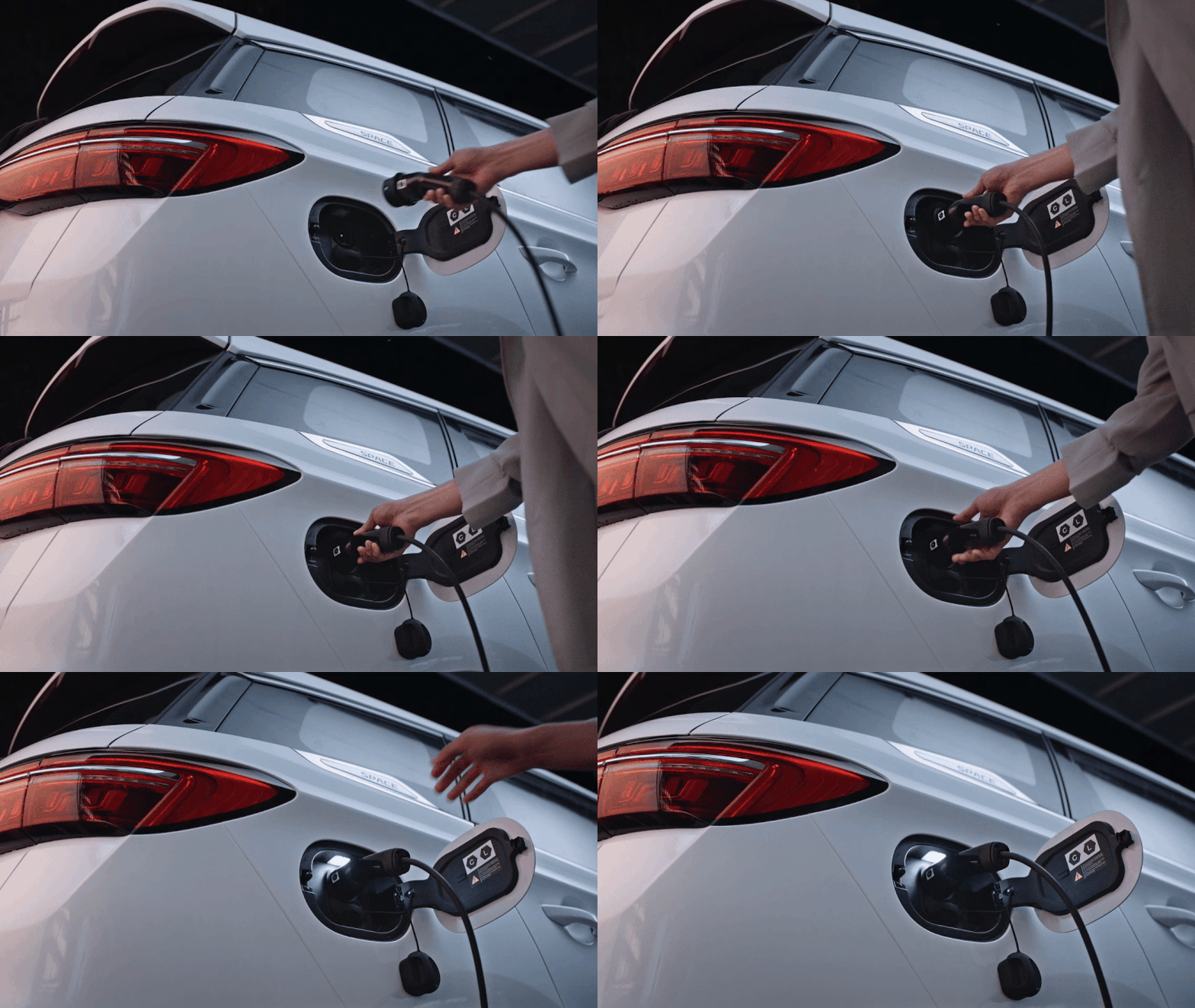
This is a new choice for the Vietnamese market, where the public charging infrastructure is still being completed: drivers get the chance to enjoy a ride as smooth as electric power, as convenient as gasoline, without having to worry about distance in places the charging network has not yet reached.
The Government’s New Policy With Extensive Tax and Fee Incentives for Electric Vehicles
From the gasoline burning engines on the streets of Saigon before 1975, through the years of straining to burn coal just to keep the intercity buses rolling, to the green glow of VinFast cars and the PHEV wave, the journey of automotive energy on Vietnamese soil is a long story of adaptation, creativity, and constant striving to rise higher.
Every stage is a chapter of its own, every fuel source a character in the story, and the thread running through all of it is a will that refuses to let any circumstance stop the wheels from turning steadily forward, whether powered by gasoline, by charcoal, or by the electric current of today.
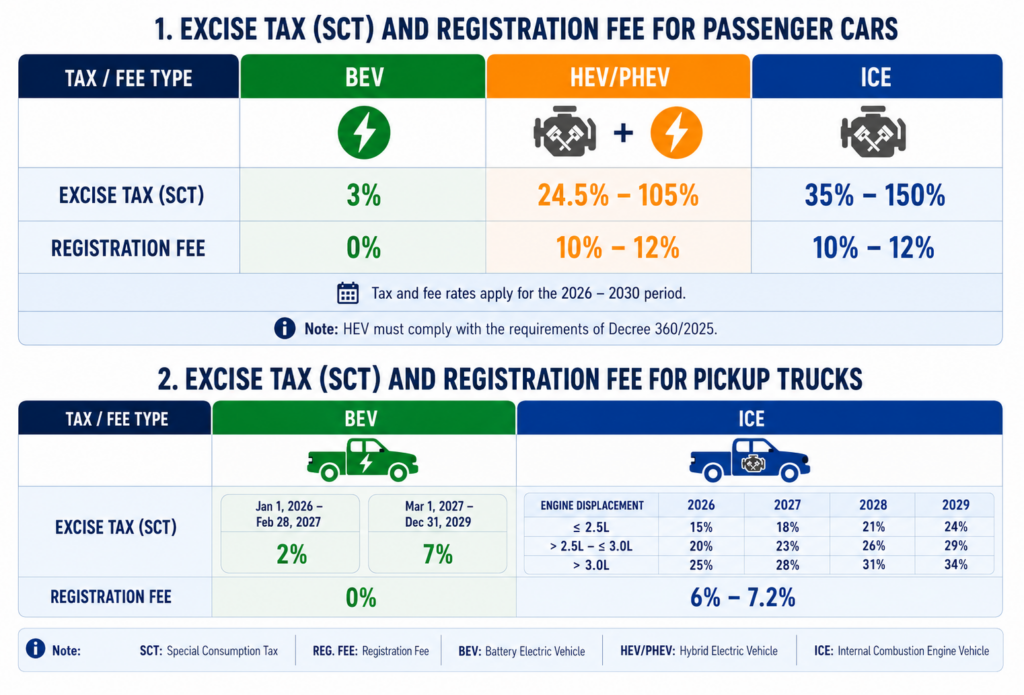
The government is rolling out a wide range of tax and fee incentive policies for BEV, officially taking effect from July 1, 2026 through the end of 2030.
- Special consumption tax: 3 percent
- Registration fee: 0 percent
VinFast electric cars are already turning every road green and filling up apartment parking lots, yet that is only the starting step on the journey to elevate the image of a national brand. The world is stirring, and Vietnam cannot afford to stand still…