

In the summer of 1917, the skies above Bavaria thundered with the sound of reconnaissance aircraft climbing to 5,000 meters. Beneath an oil-stained metal cowling sat an engine that had just emerged from the hands of BMW’s engineers. It was the BMW IIIa.
One hundred and ten years later, that sound still lives on.
Not in the sky anymore. Today it echoes off the cliffs of the Alps as a BMW M3 screams out of a corner at redline. It reverberates around the guardrails of the Nürburgring during development testing. And sometimes, amid the rush-hour traffic of Hanoi or Ho Chi Minh City, it rises briefly from beneath the hood of a BMW 3 Series before dissolving into the rhythm of the city.
The world has changed.
So has BMW.
The company has journeyed:
From aircraft engines to motorcycles.
From sports sedans to SUVs.
From natural engines to twin turbos.
And now, to electrification.
Yet through every transformation, one belief has never wavered. Mechanical engineering only becomes unforgettable when it puts a smile on the driver’s face the very moment the engine comes to life.
Perhaps that is why enthusiasts still repeat an old saying: A rooster is judged by its crow. A car is judged by the sound of its engine.
This is the brand story of BMW: 10 Years in the Sky, 100 Years on the Road.
From the Sky to the Road
In 1918, the First World War was drawing to a close. For Europe, it marked the silence of artillery. For BMW, it marked the silence of its production lines.
The Treaty of Versailles prohibited Germany from manufacturing aircraft engines. Overnight, the young company that had earned recognition through its groundbreaking IIIa engine lost the market that had defined its existence. The engines that once carried pilots into open skies suddenly had nowhere left to fly.
The years that followed demanded reinvention. Inside its Munich factories, BMW turned to building railway brakes, industrial engines, and eventually motorcycles. None carried the prestige of aviation, but they preserved something far more valuable: a team of engineers whose uncompromising pursuit of mechanical precision would become the company’s greatest asset.
By the late 1930s, BMW had found a new runway. Not among the clouds. On the road.
The Car That Made Europe Take Notice
Before sunrise on April 28, 1940, the northern Italian city of Brescia awoke to the unmistakable sound of engines preparing for the Mille Miglia, one of the most demanding road races Europe had ever known.
With war already spreading across the continent, the traditional Brescia-to-Rome route was no longer possible. Organizers replaced it with a triangular circuit linking Brescia, Cremona, and Mantova, repeated nine times to cover nearly 1,500 kilometers.
The new course was no less punishing. A winning car had to be fast enough for long straights, agile enough for mountain passes, and durable enough to withstand nearly ten relentless hours at racing speed.
Among a field dominated by Alfa Romeo, Lancia, and many of Europe’s established manufacturers, the BMW 328 Touring Coupé attracted little attention.
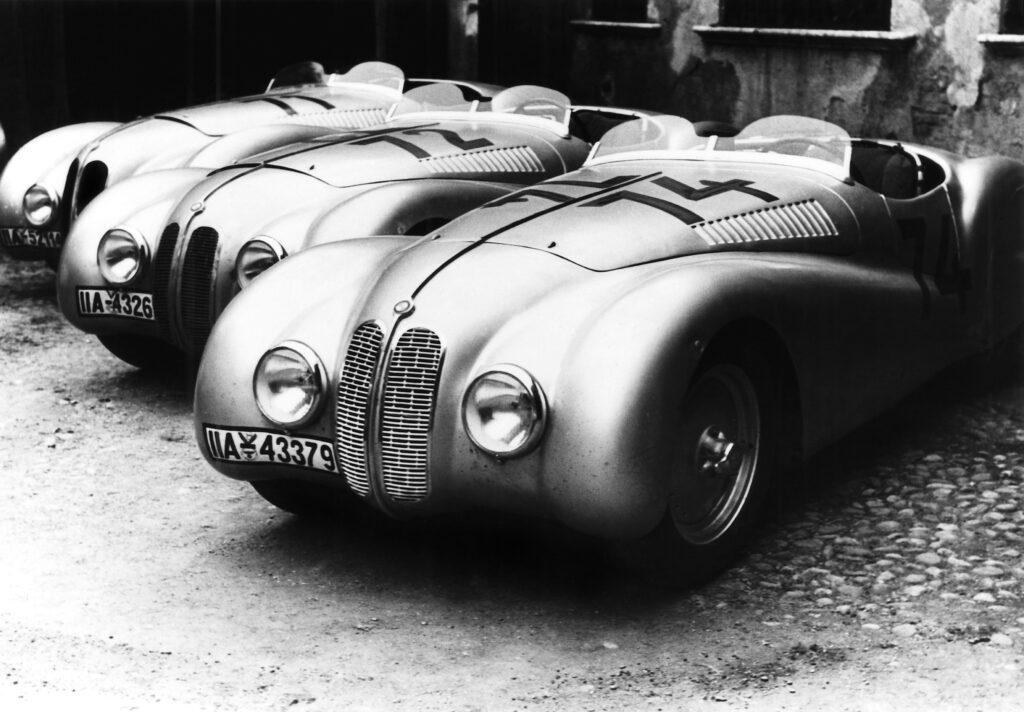
Its sleek aluminum body had been shaped to slice cleanly through the air, reducing what we now call aerodynamic drag. Its inline-six engine was hardly the most powerful in the field.
But the entire car weighed just 780 kilograms. In racing, outright power is only part of the equation. The lighter the car, the faster it can become.
Hour after hour, the BMW remained within striking distance of the leaders. When it crossed the finish line nearly ten hours later, dust from northern Italy still coated its aluminum bodywork. Its average speed stood at an astonishing 166 km/h.
That victory changed more than a race result. From that day forward, Bayerische Motoren Werke was no longer remembered solely as the company that built aircraft engines capable of conquering the skies. It had become the company that built automobiles people genuinely wanted to drive.
The Sedan That Defined BMW
Before reading on, take a moment to watch Kompat Detailing’s restoration of a classic BMW 3 Series. It is the kind of car you simply fill with fuel, turn the key, and drive. No second thoughts required.
In 1968, BMW engineer Alex von Falkenhausen slipped a newly developed two-liter engine into the compact body of the 02 Series as an experiment. The moment the prototype was finished, everyone saw the same thing. It felt light. It felt agile. And it felt full of promise.
That experiment reached its final form in the summer of 1975. Inside BMW’s exhibition hall in Munich, a silver sedan slowly rotated beneath the lights. A small plaque stood in front of it, bearing just two words.
3 Series.
Fifty years have passed since that debut. More than 20 million BMW 3 Series have found homes around the world, making it the best-selling model line in BMW’s history.
Perhaps that explains why so many enthusiasts dream not simply of owning a BMW, but of one day parking a 3 Series, 5 Series, or 7 Series in their own garage.
Victory on the Racetrack Was Only the Beginning
On May 1, 1972, BMW established BMW Motorsport GmbH. At the time, it was a remarkably small operation. Just 35 engineers and employees working from a modest workshop outside Munich.
There was no dedicated production line. No expectation of building BMW’s next commercial bestseller. Only one clear objective. To make BMW a name that demanded respect on the racetrack.
The project was led by Jochen Neerpasch, a former racing driver who believed motorsport served a purpose far greater than collecting trophies. A victory meant little unless every lesson learned on Sunday could make Monday’s road car a little better. That philosophy became the foundation of BMW M.
A racing circuit has no patience for engineering shortcuts. Few places reveal a car’s weaknesses more ruthlessly than the Nurburgring Nordschleife.

Stretching more than 20 kilometers, every lap subjects a car to relentless acceleration, brutal braking, rapid direction changes, and sustained mechanical stress. One component performing even slightly below its limit can cost valuable seconds. Or end the race altogether.
BMW engineers therefore treated every competition as a full-scale engineering experiment. What survived the racetrack eventually found its way into production cars.
More precise suspension geometry. Smarter limited-slip differentials. Cooling systems capable of maintaining peak performance under punishing conditions. Every improvement earned on the circuit eventually benefited drivers on public roads.
Then came 1986.
The BMW M3 was born, originally developed to satisfy homologation rules for touring car racing. Few could have predicted that a machine created to meet a technical regulation would become one of the most celebrated performance cars in automotive history.


Over the decades that followed, BMW M amassed thousands of victories across touring car championships, from the European Touring Car Championship to DTM. The division also left its mark on Formula 1, powering Nelson Piquet to the 1983 World Championship with BMW’s turbocharged engine.
Those victories deserve their place in history.
Yet ask the engineers at BMW M what makes them proudest, and the answer is unlikely to be found inside a trophy cabinet. It is found somewhere much more ordinary. On a Monday morning commute. A BMW M3 carrying its owner to work with perfect civility. Then, a few days later, arriving at a racetrack almost exactly as it left the office parking lot. Perhaps with nothing more than a different set of tires.
Three BMW Signatures in Design and Engineering
Long before BMWs became a familiar sight on the streets of Ho Chi Minh City, Hanoi, Da Nang, or Can Tho, every car leaving Munich already carried a handful of unmistakable signatures. They are the kind of details that require only a glance. Even people with little interest in cars recognize them instantly.
The Kidney Grille
For more than nine decades, the kidney grille has been the face of BMW. It first appeared in 1933, at a time when the front of a car served as the visual identity of an entire brand.
Over the years, its proportions have changed constantly. Sometimes it appeared slim and understated. Sometimes it grew larger and more assertive.
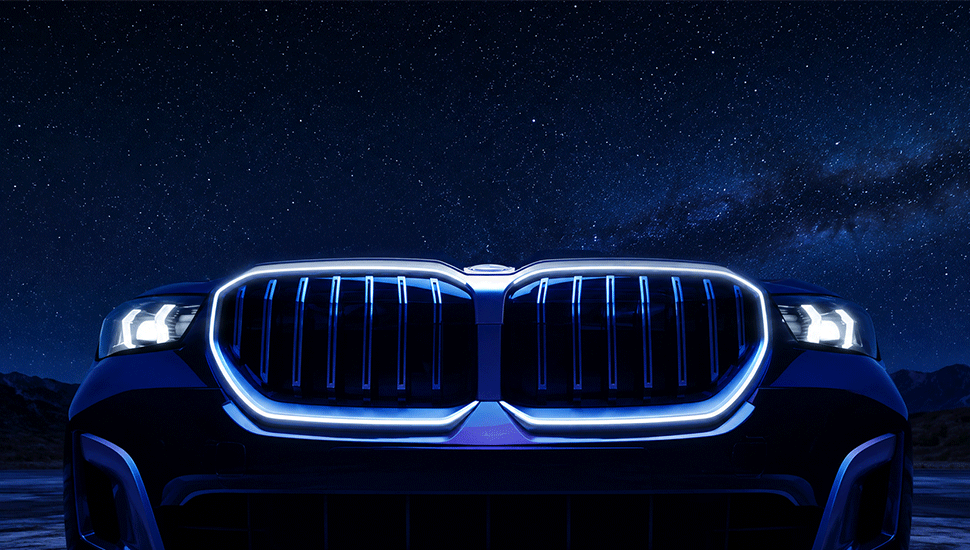
More recently, it has even illuminated itself, becoming a design statement for BMW’s electric future. Yet regardless of its size or shape, one thing has never changed. It remains the first feature people notice before saying,
“That’s a BMW.”

Laserlight Dual Headlights
If the kidney grille is BMW’s face, then its headlights are its eyes. BMW’s signature dual-headlight design, enhanced by Laserlight technology, cuts through darkness and heavy fog with remarkable clarity.
Compared with conventional LED systems, Laserlight projects significantly farther down the road, allowing drivers to see hazards sooner and drive with greater confidence after sunset. Technology, in this case, serves a simple purpose. Helping the driver see farther. And drive better.
TwinPower Turbo
Beneath the hood lies the heartbeat of BMW’s driving character. TwinPower Turbo delivers immediate throttle response, smooth power delivery, and effortless acceleration throughout the rev range. It creates exactly the sensation BMW drivers have always pursued. The higher the engine spins, the faster the driver’s pulse begins to race.
Over BMW’s 110-year history, one name from the past has unexpectedly returned. Neue Klasse was originally introduced with the BMW 1500 in 1961, the model widely credited with rescuing BMW from financial uncertainty and laying the foundation for the sports sedans that would define the brand for generations.
More than six decades later, BMW has chosen that very name once again. This time, it belongs to the company’s first dedicated next-generation electric vehicle platform. The new era begins with the all-new iX3, followed by the fully electric successor to the 3 Series.
Reusing the name is far more than an exercise in nostalgia. It quietly reminds us that BMW’s identity has never been tied to a particular engine, fuel type, or technology. Its greatest strength has always been its willingness to reinvent itself whenever the world changes.
Just as it did more than a century ago, when the engines that once ruled the skies were forced to find a new purpose on the road.

BMW Becomes Part of Vietnam’s Automotive Story
Back in the 1990s, a silver or black BMW 3 Series parked outside a luxury hotel in Hanoi or Ho Chi Minh City was a familiar sight. Its owner would step out carrying a slim leather briefcase, lock the door by hand, and disappear into another business meeting.
That image repeated itself for years.
Gradually, BMW became closely associated with a generation of entrepreneurs who came of age alongside Vietnam’s economic transformation.
Beginning in 1994, BMW became one of the first premium automotive brands to assemble vehicles in Vietnam, even before Mercedes-Benz. Yet for much of its first two decades, the brand remained beyond the reach of most buyers.
At the time, 95 percent of Vietnamese consumers were still choosing between Japanese and Korean cars. A German luxury marque like BMW belonged to a very different world.
A new chapter began in 2018, when BMW deepened its partnership with THACO AUTO, expanding its nationwide retail and after-sales network. Four years later, the 3 Series, 5 Series, X3, and X5 entered local production at the THACO Chu Lai Industrial Complex, marking another milestone in BMW’s long-term commitment to the Vietnamese market.

More than thirty years have passed, the technology inside BMWs has changed almost beyond recognition.
Mechanical keys have given way to smart keys.
Analog gauges have become seamless digital displays.
Even the engine note, once one of BMW’s defining signatures, has grown quieter in the age of electrification.
Yet one image remains exactly the same. The owner still chooses the driver’s seat. Both hands rest naturally on the steering wheel. A smile appears when the road opens ahead. Another when the next sweeping corner comes into view.
There is an old saying: A rooster is judged by its crow.
For BMW, the sound of its engines has never been just another mechanical note. For 110 years, it has been the voice of an engineering philosophy born beneath the skies of Bavaria, carried across roads around the world, and ultimately woven into the rhythm of Vietnam’s streets.
It is a quiet reminder to every member of the Suốt Ngày XE community that BMW has never lost its identity. Not even when the engine falls silent.

BMW’s First 110 Years in a Nutshell
Most automakers began their journey on the ground. BMW began in the sky. It would spend more than a decade there before finally putting wheels on the road.
1910s
BMW was founded in 1916 as an aircraft engine manufacturer. In other words, the company’s story began above the clouds, not on asphalt.
1920s
BMW acquired Fahrzeugfabrik Eisenach, along with the rights to produce the Dixi 3/15, Germany’s licensed version of Britain’s Austin 7. Its first automobile may have carried British roots.
1930s
The BMW 328 arrived and immediately changed the company’s reputation. Built around a purpose-designed chassis and powered by the M328 engine, the lightweight roadster won the 2.0-liter class at the Nürburgring in its debut year.
1940s
World War II forced BMW back into military aircraft production. Bombing raids left the company’s factories heavily damaged, and survival meant building whatever could be sold, from cookware and kitchen equipment to bicycles and other everyday metal goods.
1950s
The tiny BMW Isetta debuted in 1955, offering an affordable solution during difficult economic times. It helped generate sales. But it wasn’t enough. By the end of the decade, BMW stood on the edge of bankruptcy.
1960s
Everything changed with the arrival of the Neue Klasse. Its new generation of four-door sedans and two-door coupes transformed BMW from a struggling manufacturer into a genuine premium sports sedan brand. The blueprint for modern BMW was born.
1970s
BMW founded BMW Motorsport GmbH. Soon after came the first 5 Series, followed by the 3 Series, 6 Series, and 7 Series. Together, they established the numerical naming system that continues to define BMW’s lineup today.

1980s
BMW steadily expanded its portfolio while reinforcing one simple reputation across every segment: Ultimate driving machines. The decade also laid the foundation for BMW’s emergence as a truly global premium brand.
1990s
BMW acquired the Rover Group, bringing Rover, Land Rover, MINI, and MG into its portfolio. Yet in 1998, BMW secured something far more valuable: the rights to the Rolls-Royce name and logo. That same year, it launched the BMW X5, official entry into the luxury SUV market.
2000s
BMW sold most of the Rover Group, choosing to retain only MINI. In 2003, Rolls-Royce Motor Cars officially began operating under BMW ownership. The company returned its focus to what it did best. Premium sports sedans. Luxury coupes.
2010s
The BMW i3 became the company’s first mass-produced electric vehicle, opening an entirely new chapter for BMW’s electric ambitions. In 2016, BMW celebrated its centennial just as the global automotive industry entered the age of electrification.
Today (2026)
BMW now moves forward on three parallel paths. Internal combustion engines. Plug-in hybrids. And fully electric vehicles built on the all-new Neue Klasse platform that rescued the company more than sixty years ago. History, it seems, has come full circle.