

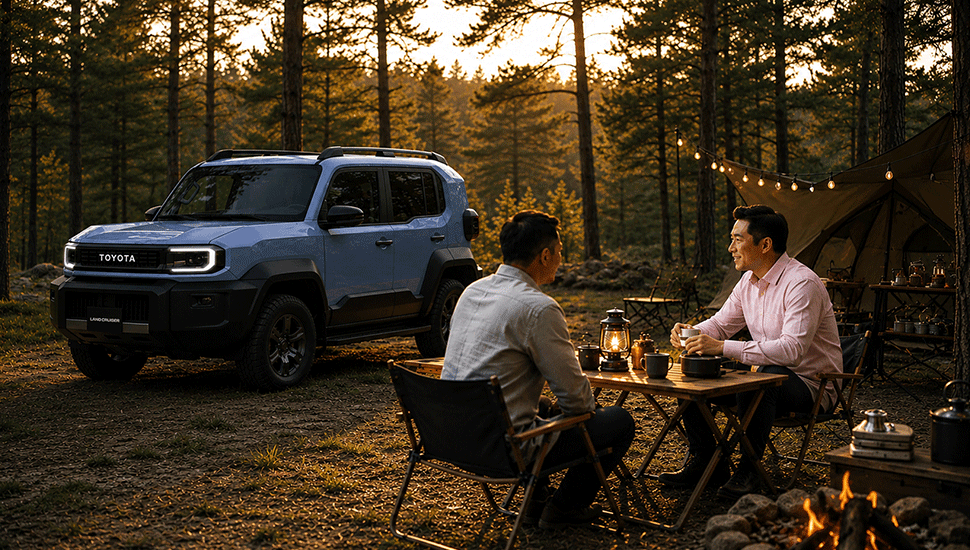
I ran into Martin 911 by chance at a meetup, his eyes still carrying that same curious spark as the day he first saw an Aston Martin and a Porsche 911 parked at home. He’s not an engineer, and he’s not a reviewer either, just someone who watches the car market with a rare kind of innocence, the sort of innocence that lets seemingly naive questions land right on the heart of the matter. Today’s topic is the newest recruit to a legendary family: the Land Cruiser FJ.
In your view, what sets the Land Cruiser FJ apart from a regular Land Cruiser?
Martin 911 laughed, the laugh of someone who had just been asked exactly the question he was waiting for. “That is a good question, because it assumes there is such a thing as a ‘regular Land Cruiser’, but honestly, no version of this name has ever been regular.
The Land Cruiser FJ is the baby of the family, smaller, lighter, and of course cheaper than its older siblings carrying the Land Cruiser name. But do not let the smaller frame fool you. The FJ still carries the same fire the whole family has been proud of for seven decades. Its full name, Freedom & Joy, already tells you this is not a car built to save fuel, it is built to widen the radius of a person’s life.

He paused, took a sip of his latte, and added like a closing verdict: “If the regular Land Cruiser is a vow, the FJ is that same vow, just rewritten in a language that is easier to afford.”
When did the Land Cruiser legend actually begin?
Martin 911’s eyes lit up, the kind of glow a kid gets right before a bedtime story. “In the early 1950s, the Japanese government commissioned Toyota to build a lightweight military vehicle, shaped somewhat like the American Jeep, but required to be one hundred percent homegrown Japanese, that very Japanese kind of national pride. At first they called it the Toyota Jeep BJ.
By 1954, once the guns had fallen quiet, the name Land Cruiser was born, and from that point on it went on to rule every kind of terrain.”
“But a name is just a name, something to tell A from B. What actually built the legend were the endless journeys: climbing Mount Fuji, crossing the deserts of Africa, cutting through the old growth forests of the Amazon, chewing up the harshest roads across Asia. Even today, in the deserts of the Middle East or the highlands of Africa, relief organizations, armies, and expedition teams still reach for the Land Cruiser first, because it is cheaper than a Land Rover Discovery, yet just as capable of bulldozing through anything.”
How many branches does the Land Cruiser family have, and where does the FJ fit in?
Martin 911 burst out laughing, as if the question had touched exactly the kind of comparison he loves making. “I like to think of the Land Cruiser family the way I think of Vietnam’s big family dynasties, like Son Kim, Ly Qui, or Johnathan Hanh Nguyen.
The eldest is the Land Cruiser 300, the purest bloodline, the one Toyota pours all its top technology into, built for the wealthy, business people, officials, anyone who needs a car that is ready for any mission at any moment.
The second child is the Land Cruiser Prado, and as you probably know, you can rarely buy one at the listed price. The Prado still holds onto that off-road spirit in full, just tailored a little more compact, a little more accessible, right for families who need a seven seat SUV that can handle both city streets and hunting trips.
I always joke that if the big boss drives a Land Cruiser 300, the subordinate, no matter how mountain high his wallet is, would only dare pick the Prado. That is what you would call knowing your place. People who handle big things do not turn a car into a big deal.
In July 2026, here in Vietnam, the family welcomed its newest member, the Land Cruiser FJ. Younger, smaller, lighter, and of course the cheapest of the three branches. Before that, the FJ had already made its global debut at an event held in Tokyo, Japan.”
Why did Toyota need to give birth to another version called the FJ?
“For decades, the Land Cruiser name came bound to a certain prejudice: if you wanted the real spirit of off-roading, you had no choice but to accept a price tag in the billions of dong, there was simply no other way.”
“That very gap is what pushed Toyota to look for a new direction, first to widen the brand’s reach, and only after that to think about business. The solution they landed on was to clone the Land Cruiser DNA and bring it closer to the mass market, without losing the dominant character that built the model’s name in the first place.
The answer is the FJ, built on the IMV platform, sharing its architecture with the ninth generation Hilux, still faithful to a separate body-on-frame chassis instead of the unibody construction found in city cars like the Yaris Cross.
“The key detail sits in the Super Short Wheelbase. This design lets the FJ turn tighter, gives it a near perfect approach and departure angle, and still keeps eighty percent of the family’s off-road grit. Toyota did not just shrink the original Land Cruiser and keep the multi-billion price tag, they built an entirely new model from the old platform, keeping only what absolutely had to stay.”
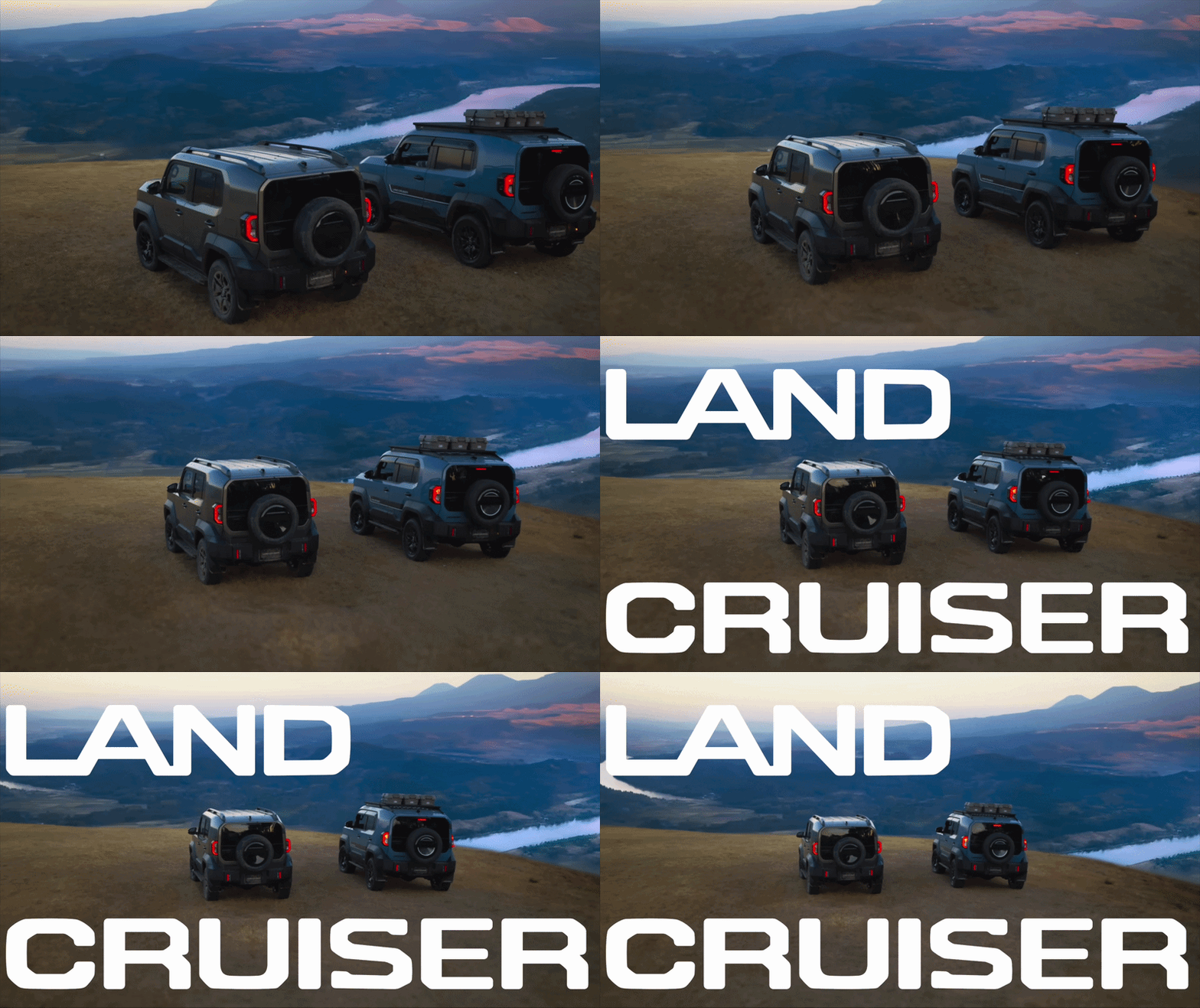
A 2.7 liter engine, 165 horsepower. Four wheel drive, with a rear differential lock, the kind of gear that only serious off-roaders truly appreciate. A side hinged tailgate, spare tire mounted on the rear door, classic through and through. Along with that comes a whole lineup of accessories so everyone can build it their own way.
He gave a little smirk: “And that naturally aspirated 2.7 liter engine is still right there, famous for its durability, proven across millions of aging drivers around the world. The only catch is that it drinks fuel the way a baby drinks its mother’s milk.”
Some people say Toyota could just glue a Prado and a Fortuner together and call it a Land Cruiser FJ, what do you think?
Martin 911 paused for a beat. “Life does not always work out to one plus one equals two. On the surface, this comparison sounds reasonable: take the family car build of the Fortuner, add the off-road character of the Prado, and out comes the FJ. But that is the view of a new driver, someone standing outside looking only at the spec sheet, never having touched the actual engineering roots.
“The FJ was not born from adding two existing models together, the way the Xforce was simply stretched into the Destinator. It was built independently on the IMV platform, sharing architecture with the ninth generation Hilux, keeping the separate body-on-frame chassis, and in particular, using a super short wheelbase configuration that neither the Prado nor the Fortuner has ever had.
That is a completely different design problem, not a matter of cutting and pasting interior parts here and underpinnings there. If building a new legend really were as simple as combining two old cars, every automaker would be doing it for a quick win, and Toyota would not have needed to assign a dedicated design team to the FJ.”
- Project Chief Designer: Koji Inoue
- Exterior Design: Lu Yi, Kosuke Kubo, Kohei Toyoda
- Interior Design: Yuki Ujita, Makoto Anzai
- Color Design: Momo Kumano
“In other words, the FJ resembles the Prado and the Fortuner in spirit, not in mechanical addition and subtraction. Park the three cars side by side and you might catch a few familiar traits. Sharing an engine is completely normal in this industry, the 1.5 turbo configuration found in most Chinese cars all comes from the same furnace. But when one Land Cruiser FJ parks next to another, they somehow look twice as good.”
Will other high riding models lose their fire now that the Land Cruiser FJ has arrived?
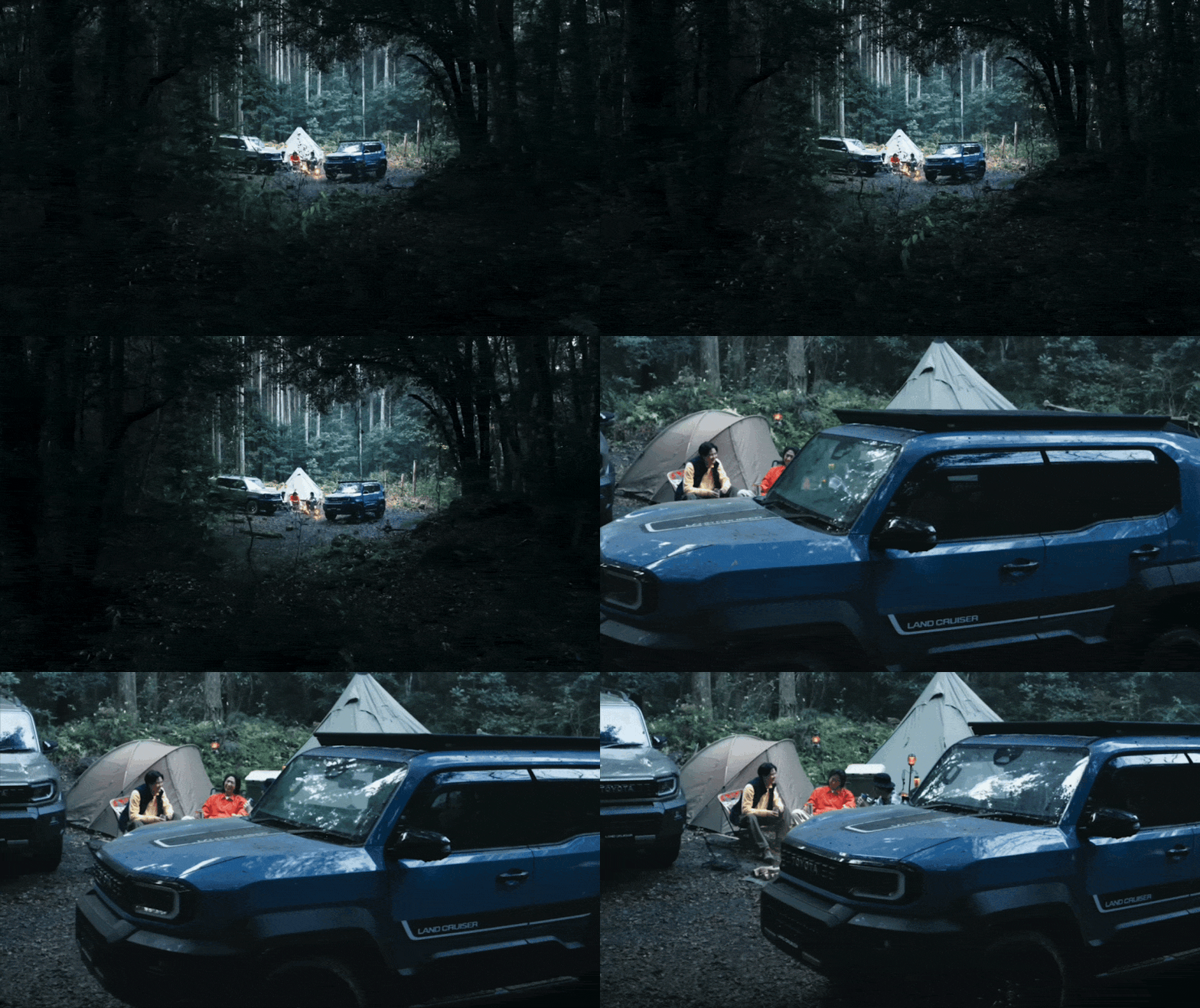
Martin 911 gripped his coffee cup tightly and thought for a moment before answering. “I do not think they will lose their fire, I think they might lose the whole kitchen :) At a price point of 1.2 billion dong, the FJ lands in a very particular position, there is really no model that stands as a true head to head rival. Boxy design, a genuine separate chassis, and endless accessory customization, the FJ pretty much stands in a world of its own.”
“At that kind of money, a buyer could just as easily ask their spouse and go for a high riding seven seater like the Ford Everest, Hyundai Santa Fe, or Kia Sorento, or scrape together a bit more and go German with a five seater like the BMW X1 or Audi Q3. That is the real battlefield the FJ is stepping into, not some mismatched dance with the Suzuki Jimny off to the side.“
He wrapped up the conversation with that same easy, unguarded smile: “For me, three things make the FJ’s appeal very clear. First, it carries the full spirit of the legend down to a price that is actually within reach. Second, it does not dilute the off-road character that built the Land Cruiser name in the first place. And finally, its shape makes a striking statement the moment it is parked, or the moment someone steps in or out of it.
Everything else is just picking a color, deciding on the down payment, choosing the loan term, then taking delivery and getting your plates. If you happen to have license plate number 9, let’s grab a beer together! 🍻”