


On August 8, 2018, Mitsubishi achieved what few expected: turning the mid-range MPV Xpander into a phenomenon on Vietnamese roads. Xpander arrived at the right moment, in the right place, at the right price — shaking the entire market.
On December 1, 2025, it was Destinator’s turn to roll out. Only test drives so far — not yet the full Slalom Test or Moose Test — but enough to sense its build quality and driving feel. The big questions now are: Can the epic magic repeat? Can Destinator stand on the shoulders of its predecessor?
Not easy — but not impossible either. To dive deeper into the opportunities and challenges ahead for Destinator, we spoke with Martin 911, editor of “Suốt Ngày XE,” who has followed every step of Mitsubishi in Vietnam for the past three decades.
Hello Mr. Martin 911. Many people say Destinator is meant to replace the Outlander, which no longer has the strength to compete in the market. What’s your take on that?
This question has been around ever since the first images of Destinator appeared in Indonesia in May 2025. But when we talk about “replacement,” the story is a bit more complicated.
Outlander has been in Vietnam for 10 years — like an old general who has seen many battles. Over the years, rivals like the Mazda CX-5, Hyundai Tucson, and Honda CR-V have evolved significantly. Anyone who has driven an Outlander can feel its excellent ability to handle rough terrain and muddy roads.
But today, Outlander is bringing an old suit of armor to a new battlefield: outdated interior, lagging technology, and a high price tag. For that reason, the Outlander should drive off toward the horizon.

And Destinator? I don’t think this is simply a “replacement exercise.” Mitsubishi is playing a different game. They saw a gap between Xpander (7-seat MPV) and Outlander (5+2 SUV), and then looked outward at the broader market. From there, they decided to create a more accessible 7-seat crossover. This is a “fill the gap” strategy — not “replace the sibling.”
You mentioned strategy. When launching a new model like Destinator, what do carmakers typically consider?
This is the question that keeps every automaker awake at night. Let me take you back to Xpander — the model we still call a phenomenon.
On August 8, 2018, when Xpander launched, Mitsubishi played a brilliantly calculated move. They read the “music sheet” of the Vietnamese market. At that time, Vietnamese buyers were longing for a modern 7-seat MPV that wasn’t too expensive — and crucially — had to look good. Avanza was too dated. Innova was priced arrogantly high.
Mitsubishi launched Xpander at 550 million VND — low enough to reduce the burden of borrowing. They also prepared spare parts and components carefully because, for Vietnamese buyers, maintenance cost is a matter of survival. The result is what you’ve seen: Xpander communities sprouting across the country, north to south, east to west.
Xpander reshaped Mitsubishi’s entire business and brand strategy after years of unsuccessful models such as Grandis and Zinger in the 2000s, and later Outlander, Pajero, and Triton in the following decade.
Now, with Destinator, I believe Mitsubishi — after 30 years in Vietnam — has learned enough lessons to apply a proven formula with far fewer obstacles.
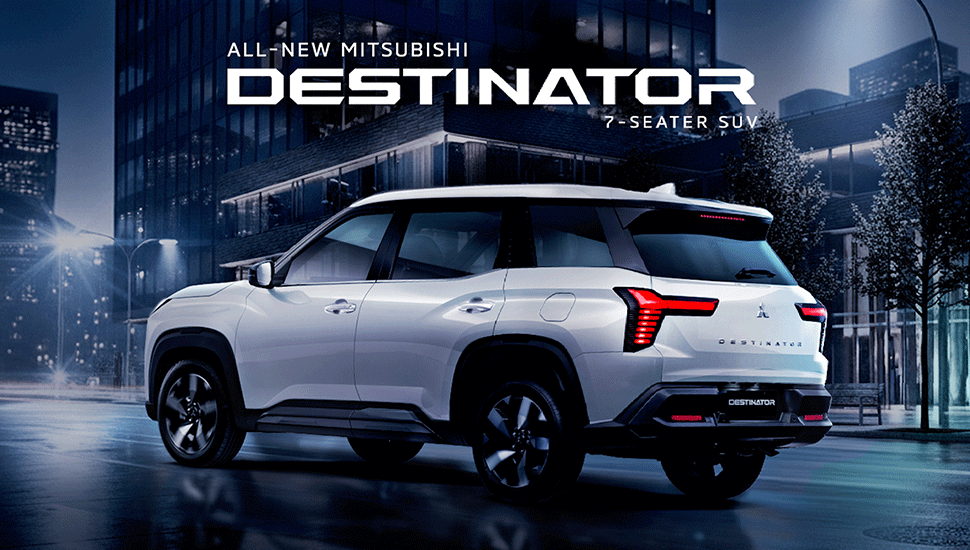
When launching a new model in any market (besides matters of feng shui, which depend on the chairman’s local beliefs), automakers must consider many factors. Here are just a few examples:
Timing
They chose the year-end season — cleaning season, deal-closing season, ting-ting season for the market. It’s a fun time for both car buyers and dealerships.
Pricing
This is life-or-death. Destinator is priced around 800 million VND — higher than Xforce to separate segments, but lower than the fully loaded CX-5 to attract buyers.
Consumer preferences
Vietnamese buyers want high ground clearance and strong engines. Destinator offers the highest ground clearance in its class and adds a turbo. And with extra seating needed for extended family, Destinator’s 7 seats are ready.
Spare parts
Mitsubishi has mapped Southeast Asia as a core market, so parts availability is no longer a nightmare like during the early Pajero Sport days.
In the 700–800 million VND segment, Destinator faces more than 10 rivals like Innova Cross, Mazda CX-5, Ford Territory, Kia Sportage… What advantages give Destinator a chance to roll forward?
In the 700–800 million menu, we have many options, including the ones you mentioned — not to mention strong contenders from China like the BYD Sealion 6, which travels 100 km without a drop of gasoline, or the stylish Jaecoo J7 with its impressive tech dance.
Innova Cross 2.0G
Reliable and durable like a buffalo, but fundamentally still an MPV. Sitting in the 3rd row on long highways or mountain roads is not comfortable. Destinator wins here because it feels more like an SUV — higher stance, more solid feel, and not mistaken for a service vehicle.
Mazda CX-5
A fearsome opponent for any model in its price territory. But CX-5 has only 5 seats. That’s its Achilles heel — and Destinator will strike right there with its 7-seat capacity.
Ford Territory
Sharp-looking, especially the front. Destinator wins with 7 seats again — but it may lose buyers who already have a soft spot for Trump.
If we compare Destinator Ultimate vs. Territory Titanium, the buying decision really comes down to design & brand (unless you care about Mitsubishi’s cheaper maintenance):
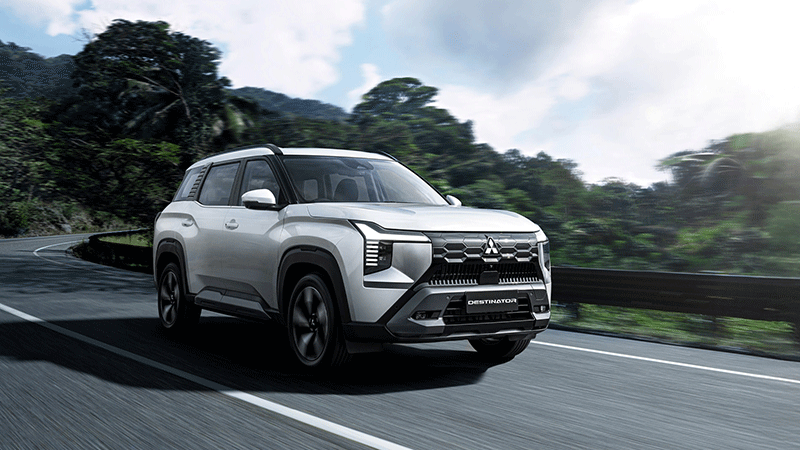

- Overall length: 4,680 / 4,685 mm
- Wheelbase: 2,815 / 2,726 mm
- Seating: Destinator 7 / Territory 5
- 1.5 turbo engine, power 163 / 160 hp
- Auto high-beam LED lights
- 12.3″ center screen, 8 speakers
- Hands-free power tailgate
- Auto-folding mirrors
- 360 camera, 6 airbags, dual-zone AC
- Collision sensors, tire pressure monitoring
- Blind spot warning, lane departure warning
- Destinator Ultimate: Active Yaw Control
- Territory Titanium: lane-keeping assist
- Neither has HUD yet
Kia Sportage
Very beautiful and modern. But the X-line 1.6 turbo already touches 1 billion — a different tier.
And those are just the two-row rivals. The top-spec Destinator, priced at 855 million VND, also puts serious pressure on its three-row, seven-seat counterparts that all sit in the billion-dong bracket — models like the Mazda CX-8, Kia Sorento, Toyota Fortuner, and Hyundai Santa Fe.
So what are Destinator’s core strengths?
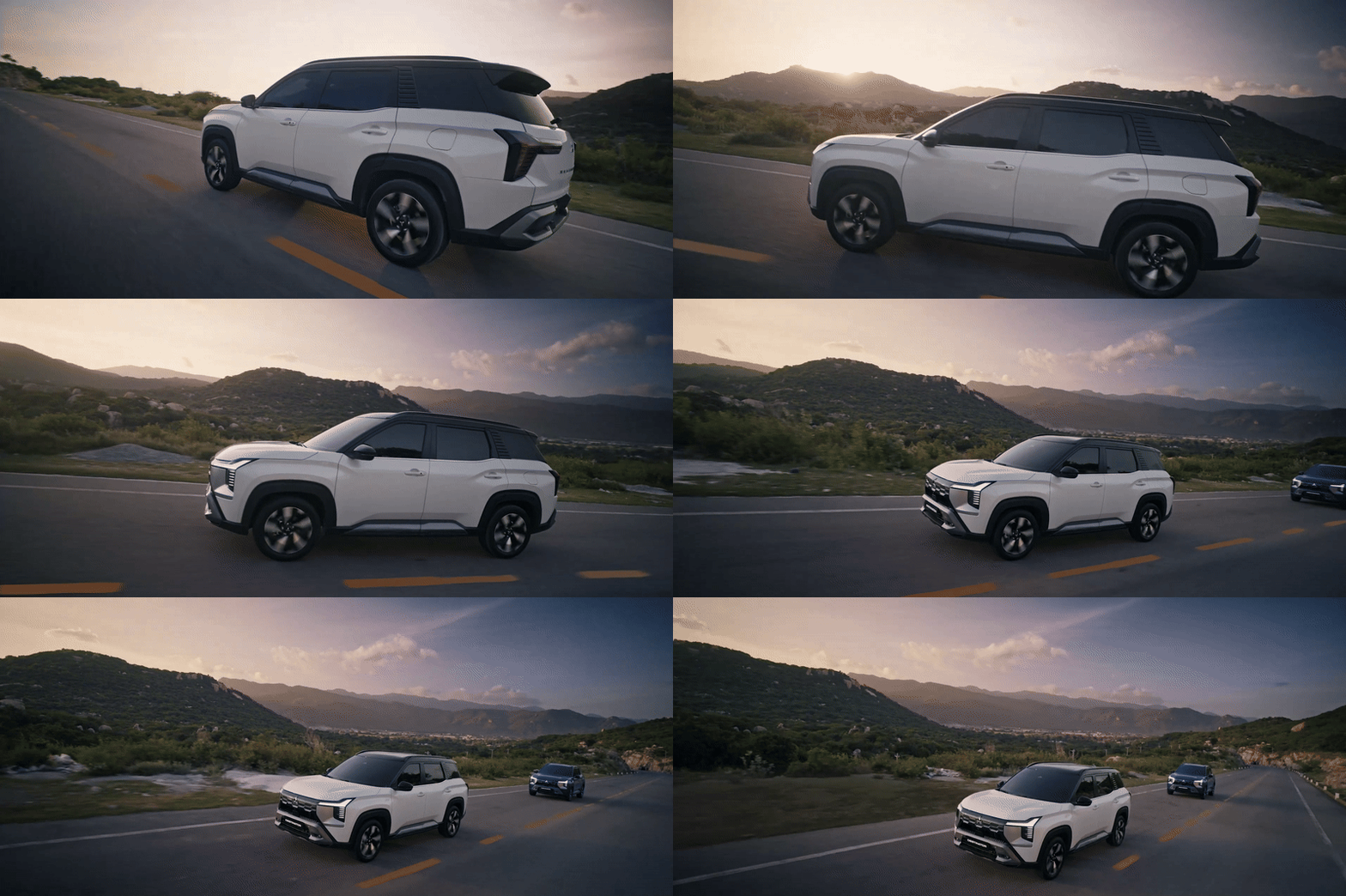
- 1. A 7-seat layout in a body that isn’t oversized
CX-5 doesn’t have it. Territory doesn’t convince. Only Innova Cross does — but Innova still carries MPV DNA. Destinator gives you 7 seats yet still feels like a tall, well-balanced SUV.
- 2. Mitsubishi’s ecosystem in Vietnam
When buying a car, customers aren’t just buying something to drive or to shield from sun and rain — they’re buying after-sales service. Mitsubishi has a nationwide network, abundant parts, and mechanics familiar with the brand. Destinator even has a built-in hotline button.
- 3. Interior convenience
Destinator lacks nothing that drivers or passengers need inside the cabin. Storage compartments everywhere, foldable tray tables for the second row. Add an aftermarket HUD (around 3 million VND) and Destinator becomes top-tier.
But the invisible strength of Destinator might be something not shown on any spec sheet: the extraordinary success of Xpander. When people think of Mitsubishi, they think of Xpander. And they’ll be curious: “Can Mitsubishi do it again?” — that curiosity alone creates free viral exposure for Destinator.
So in summary — can Destinator create a “wave” like Xpander did in 2018?
There’s a saying: “Lightning doesn’t strike twice in the same place.” Xpander was a phenomenon — the right time, right product, right price, and the right stroke of luck. Repeating that is extremely difficult.
But Destinator doesn’t need to be a second Xpander. It only needs to be itself — meeting the needs of a specific customer group: Japanese brand, 7 seats, high clearance, 1.5 turbo, lots of features, under 800 million VND. That said, Destinator’s arrival will definitely narrow the runway for its sibling Xforce.
Vietnam’s auto market is no longer the easy feast it was in 2018. Buyers take longer to decide, have more choices, and don’t fall head over heels for new models. Even the stunning MG7 — a true beauty — struggles to gain traction. Destinator will need time — maybe 6 months, maybe a year. The compass always points north, but there’s no shortcut to becoming the number one.