

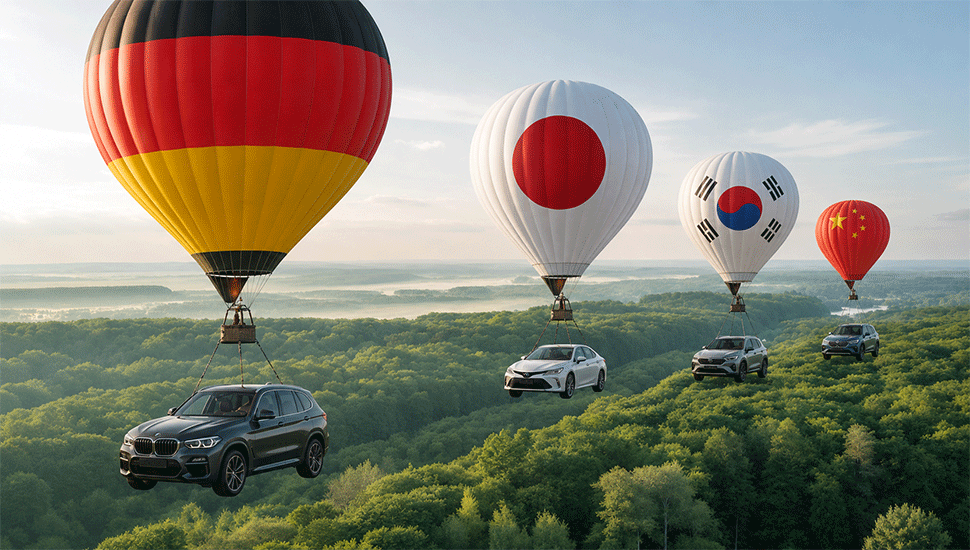
In 1945, while Vietnamese were still rattling along on bicycles and hand-pulled carts, the Germans had already perfected rocket engineering, precision mechanics so exacting they could hurl an object clean through the atmosphere.
Twenty years on, Saigon still glittered under the name Pearl of the Far East, while across the East Sea, Korea was hunched over workbenches, tightening bolts for Ford and Fiat.
Same starting line, same moment in time, yet each nation chose its own road, building strength in its own way. Decades later, looking back at the world’s automotive map, you can still see the fingerprints of those beginnings on every car rolling down the street.
There’s an old saying: “Where there’s smoke, there’s fire” and it’s no accident people sum things up this way: Korean cars are pretty, German cars are classy, Japanese cars are maddeningly good, Chinese cars are just plain maddening.
I. German Cars: Engineering Nobility
Talking about Germany’s four automotive pillars without mentioning their history is like watching an adult film on mute, or playing a war game with the sound turned off, you’re missing the whole point.
Germany is where the world’s first true automobile was born in 1886, Karl Benz unveiled the Benz Patent-Motorwagen, laying the foundation for the entire industry that followed.
From that cradle came Mercedes-Benz, BMW, VW, Audi, and Porsche, one after another – each with its own engineering philosophy, yet all sharing the same bloodline: precision down to the millimeter, the hallmark of German mechanics that built the reputation of “Made in Germany” across every corner of heavy industry, from aircraft engines in the sky to tunnel-boring machines deep underground. A German car is more than a mode of transport; it’s the symbol of an industry built on rigor.
But class comes at a price, the cost of that whiff of luxury, and long-time car people generally agree on three traits:
1/ First, the body is heavy, which gives it that planted, rock-solid feel at high speed. Carrying that extra weight means the chassis and suspension bear a heavier load, so the car ages faster once the warranty runs out. It’s no accident that car folks the world over whisper the same warning: “Whatever you do, just stay away from an old Beemer or a vintage Merc.”
Mr. Tuấn from Kombat Detailing ignored all the naysayers and stayed determined to restore his 22-year-old BMW. The result turned out beautifully, just as you can see in the video. There were even a few moments behind the wheel when he was so overwhelmed with happiness that he became teary-eyed. Congratulations, Mr. Tuấn!
2/ Next, a genuinely upscale German car, priced and specced the way it should be, is packed with technology inside, which means maintenance costs and part replacements are never cheap. That’s the inevitable price of an industry that keeps cramming the latest tech into every car just to hold onto its position.
3/ Finally, resale value looks like it shouldn’t be low, but it drops lower than you’d ever imagine. Drive a German car and you’re the king of the road. But don’t chase the German dream straight into a mountain of debt :(
II. Japanese Cars: A National Brand
Japan started building cars nearly half a century after Germany, yet went on to write an entirely different chapter of automotive history.
After World War II, a shattered Japan needed a complete rebuild, and the auto industry was chosen as one of its spearheads. Toyota, Honda, Subaru, and Nissan rose one after another amid scarce resources, forcing Japanese engineers to optimize every single bolt, every liter of fuel. That very hardship became an advantage: the lean-manufacturing philosophy of Kaizen, born at Toyota, went on to change the way the entire world runs industry far beyond just cars.
Then came the oil crises of the 1970s and ’80s, which rocked the world, fuel became more precious than gold and fuel-sipping Japanese cars flooded into the North American and European markets like a quiet, unstoppable tsunami.
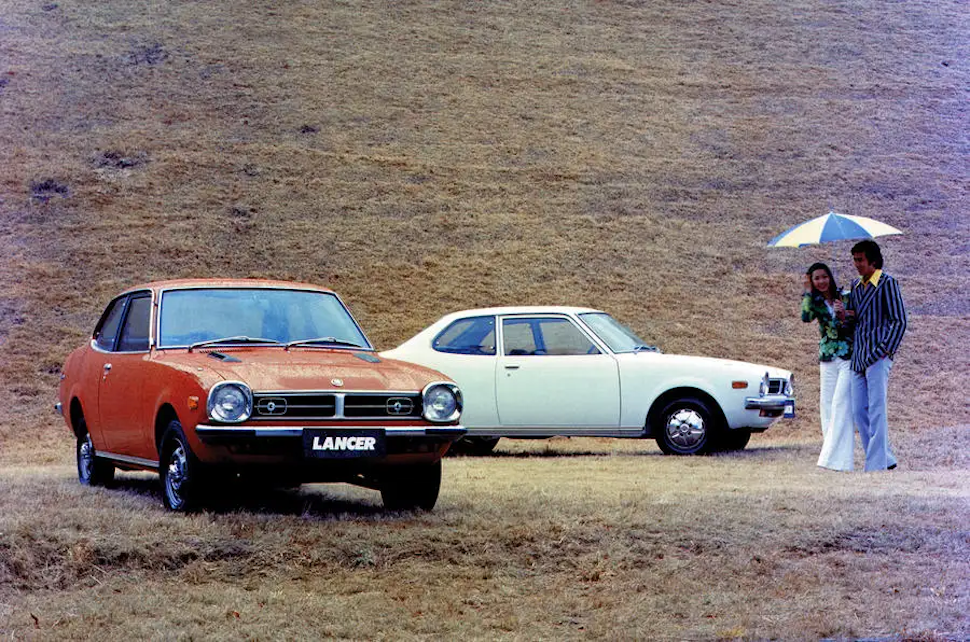
Built on that history, three traits of Japanese cars are recognized by veteran drivers and newcomers alike:
1/ Durability that’s practically legendary. It’s not unusual to find a Toyota Camry or Honda Accord still running smooth past half a million kilometers. The Japanese build cars with a “run it till it dies” mindset, prioritizing reliability over flashy tech, so these cars rarely throw a tantrum on the road.
2/ Easy on the wallet to own and maintain. Simple construction, minimal unnecessary tech, and parts available everywhere make Japanese cars an almost foolproof choice for anyone who doesn’t want a headache every time a repair bill shows up. That’s the complete opposite of German cars’ second trait, the one that always leaves people rubbing their temples.
3/ Resale value holds up well over time. Precisely because their durability and reliability have been proven, used Japanese cars keep a solid market price and don’t nosedive in value the way many luxury lines do. Buy a Japanese car, and you can rest easy not just while driving it, but when it’s time to sell.
III. Korean Cars: Hyundai and Kia, Two Yet One
If Germany is old-money nobility, and Japan the tireless workhorse, then Korea is the rising K-pop star, one who knows exactly how to dress to please the crowd.
After a decade spent as a contract manufacturer for the big players, Korea’s auto industry only truly took off in the 1970s, when Hyundai launched the Pony, widely regarded as Korea’s first domestically made car, built with design help from Italy and technology from Japan.
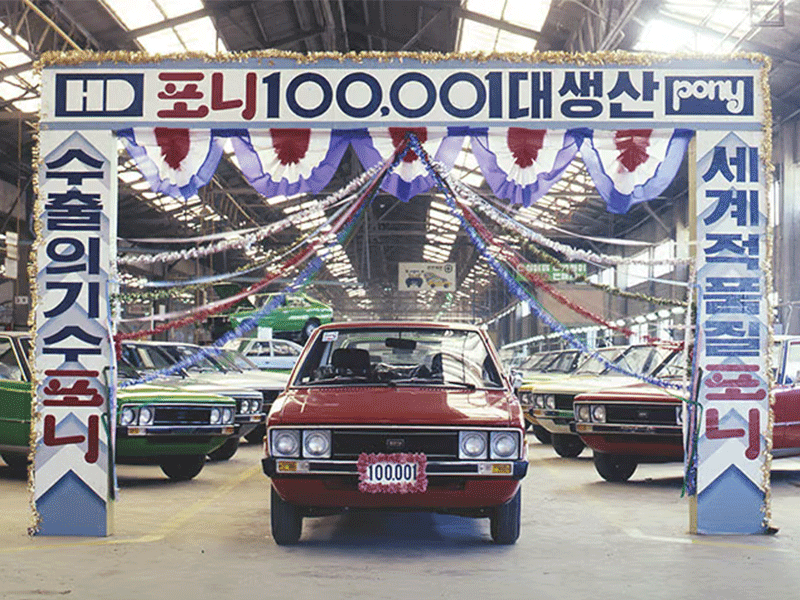
Kia, meanwhile, started out making bicycles and parts before gradually moving into cars. Then in 1998, amid the Asian financial crisis, Hyundai bought up the majority of Kia’s shares, turning two brands that once looked like rivals into siblings under one roof, sharing platforms, sharing technology, and differing only in how they “dress up” the exterior design.
- Hyundai Tucson & Kia Sportage
- Hyundai Creta and Kia Seltos
- Hyundai Venue & Kia Sonet
From that twin-sibling story, here are the three traits users mention most often:
1/ Hyundai and Kia – two brands, one soul. Many models from the two share the same platform, the same engine, the same technology, and differ only in design. So choosing between Hyundai and Kia comes down mostly to personal taste rather than any real difference in quality.
(Hyundai N family has been synonymous with high performance vehicles, built for speed and boundary-pushing innovation. Vietnamese gearheads with gasoline running through their veins have been longing for Hyundai Elantra N model to make their way here, but sadly, that dream is still a long way off.
2/ Head-turning good looks that give the big brands a run for their money. Ever since veteran designers who once worked for Audi and Bentley joined their ranks, Korean cars have undergone a stunning aesthetic transformation, sharp lines, modern interiors. Back before 2015, Vietnamese buyers were still torn between Japanese and Korean cars; not anymore. Just look at the Kia Carnival, unrivaled in the near-luxury segment, and you’ll see why.
3/ Prices that are easy to say yes to, with equipment that punches way above its class. This is Korea’s real strategic trump card: at the same price point, buyers get more comfort features and safety tech than Japanese or American rivals offer, which shortens the whole “pulling the trigger” process. Bank loan approval comes easy too.
(Korea also has two other brands – Daewoo (now discontinued) and SsangYong (now KG Mobility) – but since they’re not widely seen, Suốt Ngày XE won’t cover them in this piece.)
IV. Chinese Cars: Surprised Yet?
China’s auto industry only truly hit its stride after 2000, when the government pushed joint ventures with foreign automakers to absorb technology, while pouring enormous sums of yuan into electric vehicle research, a field where China saw a chance to “leapfrog ahead” instead of competing head-on with the German and Japanese giants that had dominated for a century.
The results paid off handsomely. In just a decade, names like BYD, Geely, Chery, and Great Wall went from unknowns to leading exporters of electric and hybrid vehicles worldwide. The BYD U9 – an electric supercar that can drive and fly – keeps stunning the world. But the editorial team would rather introduce the U7, a car for everyday life.
Even with lingering doubts about durability, three traits here draw broad agreement from users and market watchers alike:
1/ A design that echoes some big-name brand or another. Plenty of Chinese models, at a glance, instantly bring to mind a Range Rover or a Porsche, like a “concept” version that cut design costs by studying very closely what has already succeeded in the market.
2/ Comfort features that are absolutely “loaded.” Big dual screens, multi-zone massage seats, built-in karaoke, smart driver-assist systems, pretty much anything that can be stuffed into a car gets stuffed in, like a Thanksgiving turkey crammed for the oven, except there’s no special occasion required.
3/ Prices that are always good, sometimes so good you’re almost afraid to buy. Thanks to a self-contained domestic supply chain, competitive labor costs, and massive production scale, Chinese cars are typically priced noticeably lower than comparable Japanese or Korean models. More importantly, Chinese cars still lack the kind of national-brand trust that phones and home appliances from China have already earned.
Finding a Car That Fits Your Wallet and Keeps Your Wife Happy Is Still a Headache
Looking back, these four schools of carmaking are nothing alike, each nation rose from its own history, its own industrial philosophy. German cars are a story of peak engineering. Japanese cars are a story of endurance forged in hardship. Korean cars are a story of a latecomer who learned to win the market through design. Chinese cars are a story of miraculous, breakneck growth.
What about American cars?
There’s the RAM 1500, king of pickup trucks, all rippling muscle, priced at over 5 billion đồng – enough to make anyone’s ears ring in terror. People just stand there admiring it from afar; nobody’s actually daring enough to drive it off the lot and get it plated.
P.S.: Wrapping up the first half of 2026, out of the top 10 best-selling cars, VinFast’s “Made in Vietnam” electric vehicles claimed 6 spots, completely dominating the world’s four automotive pillars. Bravo, Vietnam!