

If you want to understand a country, look at the vehicles moving along its streets.
In Vietnam, cargo vans are not merely about wheels and engines—they tell a deeper story of aspiration, of a nation’s journey from hardship toward prosperity.
From the Suzuki Carry that carried entrepreneurial dreams in the 1990s, through the Ford Ranger that redefined the concept of the premium pickup, to the VinFast EC Van opening the door to a green future at the end of 2025—each generation of cargo vehicles reflects a historical chapter, a higher tier of ambition, and a decisive step in Vietnam’s modernization journey.
Suzuki Carry: Carrying the Dreams of a Generation
In the 1990s, when Vietnam had just begun opening its economy, on the dusty roads of major cities, a small white truck—without a roof, without air conditioning—became a powerful symbol of the desire to make a living and build a better life.
The Suzuki Carry, affectionately known by Vietnamese people as “Su Cóc,” was a faithful companion on a tough road to survival. With a modest payload of 500 kg, the Carry could “swallow” any terrain—from smooth asphalt to muddy dirt roads.
At dawn it hauled fresh produce, at noon heavy construction materials, and by dusk garments and textiles—“Su Cóc” never complained. Backed by Suzuki’s 30 years of experience in building compact trucks for harsh conditions, the Carry was always ready to serve.


Mr. Nam’s story is typical: “In 1998, I borrowed money from everywhere to buy a Suzuki Carry. Every morning at 3 a.m., I hauled fruit to wholesale market. At noon I took delivery jobs. In the afternoon I transported goods for shops. That truck fed my whole family, paid for my two children’s education, one of them even married and moved to Taiwan.”
That was the story of tens of thousands of Vietnamese families during the early reform era.
In a time when business opportunities sprang up like mushrooms after rain but resources were scarce, Japanese cargo vans became a magic wand—defining an entire segment: light trucks as tools of labor, vehicles of livelihood.
- Top of the market: Suzuki Van
- Vietnam vanmaker: Thaco Towner
- China van: SRM, Foton, Kenbo…
The durability of Suzuki cargo vans went beyond the engine. Galvanised steel plates are used for the entire bed to help prevent rust and corrosion. Additionally, sealer and undercoating are used in many parts of the underbody, and the stainless-steel exhaust system is rust-resistant.
The front suspension employed a McPherson strut design for good performance while retaining toughness, with L-shaped lower arms providing high level of lateral rigidity.
The rear suspension used a rigid axle with leaf springs strong enough to handle heavy loads, minimizing vertical movement when fully laden. The 5-leaf-spring mechanism is placed over the axle housing to provide additional road clearance.
The Ford Ranger Revolution of the 2000s
Entering the 2000s, as the economy began to take off, a new phenomenon appeared in the automotive market. The Ford Ranger—with its tall stance and spacious cabin—introduced a completely different definition of the pickup truck.
Pickup trucks—half cargo, half passenger vehicles—originated in the early 20th century. Back then, the first examples were crudely modified sedans, literally cut in half to create a rear cargo area. That marked the beginning of a design philosophy that would later define an entire segment: part car, part lifestyle vehicle.

If the Suzuki Carry was a pure work tool, the Ranger shattered the boundary between commercial vehicle and personal transport.
In June 2001, the Ford Ranger was launched in Vietnam with two locally assembled versions, initially favored by construction contractors and agricultural enterprises. Ten years later, it gradually created the concept of “playing with pickups” within enthusiast communities. By 2016, Ford discontinued its small car lines globally, focusing entirely on SUVs and pickups.
Over the following decade, the Ranger dominated the market overwhelmingly, consistently holding over 60% market share against five Japanese pickup rivals. Millions of Rangers are produced worldwide every year.
VinFast EC Van: The Final Piece of the Big Picture
Among ASEAN countries, Thailand and Indonesia boast strong automotive industries—but primarily as manufacturing and assembly hubs for global giants. Only two flags stand tall with true ambition, vision, and determination to assert themselves on the fiercely competitive automotive stage: Vietnam (VinFast) and Malaysia (Proton, Perodua).
VinFast embodies a grand dream. Founded in September 2017, VinFast achieved what many considered impossible: in just 21 months, it transformed muddy land in Hải Phòng into one of Southeast Asia’s most modern automotive manufacturing complexes, with automation rates reaching 90%.
VinFast does not merely build electric vehicles—it builds a complete green mobility ecosystem. From the VF e34, its first electric SUV, to the VF5, VF6, and VF7—a trio covering diverse sizes and needs, from bustling urban life to family use.

The tiny hero VF3 sparked a nationwide customization craze, dramatically boosting VinFast’s presence on the roads and pushing the Wuling Mini EV back into showrooms.
Beyond personal vehicles, VinFast extends its green vision into public transportation with VinBus electric buses, Vietnam’s first all-electric taxi service Xanh SM, and affordable Green-series commercial EVs—all working together to solve a three-in-one equation:
- Brand recognition
- Revenue growth
- Technology validation
As Hanoi and Ho Chi Minh City pilot zones restricting gasoline vehicles and encourage EV adoption to reduce air pollution, an electric cargo van becomes both an environmentally friendly choice and a competitive advantage. Logistics companies, last-mile delivery services, electronics retailers, and even small household businesses can now operate freely in city centers without worrying about truck restrictions.
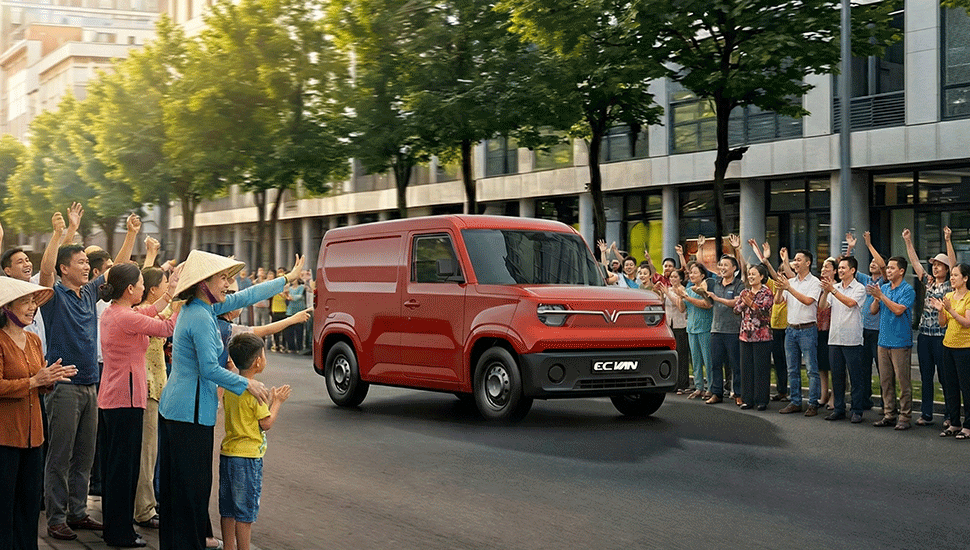
At the end of 2025, the VinFast EC Van—Vietnam’s first fully electric cargo van—officially hits the road. This is not a random move or a trend-chasing decision, but an inevitable step in completing VinFast’s electric ecosystem.
VinFast EC Van: Price 285 Million VND
- Dimensions: 3,767 × 1,680 × 1,790 mm
- Cargo box: 1,470 × 1,450 × 1,220 mm
- Cargo volume: 2,600 L | Payload: 600 kg
- Seating: 2 seats | Power output: 30 kW
- Driving range: 175 km per charge
- Fast charging: 42 minutes (10%–70%)
- Front disc brakes, rear drum brakes
- EBD electronic brakeforce distribution, traction control
- Rear tailgate opening upward like a passenger car
If the Suzuki Carry symbolized entrepreneurs transitioning from a subsidized economy to a market economy, and the Ford Ranger represented a period of strong growth, the VinFast EC Van is the image of a sustainable future.
It completes the circle: from passenger cars for families, buses for communities, to cargo vans for production and commerce—all electrified, all Made in Vietnam.
With VinFast’s rapidly expanding nationwide charging network, the EC Van avoids the biggest barrier of electric vehicles: range anxiety. Still, the heavier the load, the faster the battery drains.
That said, the VinFast EC Van is designed primarily for short-distance urban transportation. A gasoline-powered van like the Suzuki Eeco, Thaco Towner, or SRM can easily handle long-distance trips, day and night. (The author regularly transports roasted coffee from a factory in Phan Thiết to cafés in Saigon twice a week using a gasoline van)
❉ ❉ ❉
Any van with a cargo length of around 1.9 meters can be converted into a mobile home—a nomadic lifestyle trend enthusiastically embraced by the travel community. The feeling of being outdoors, slightly secretive, slightly rebellious, is something words can hardly describe.