

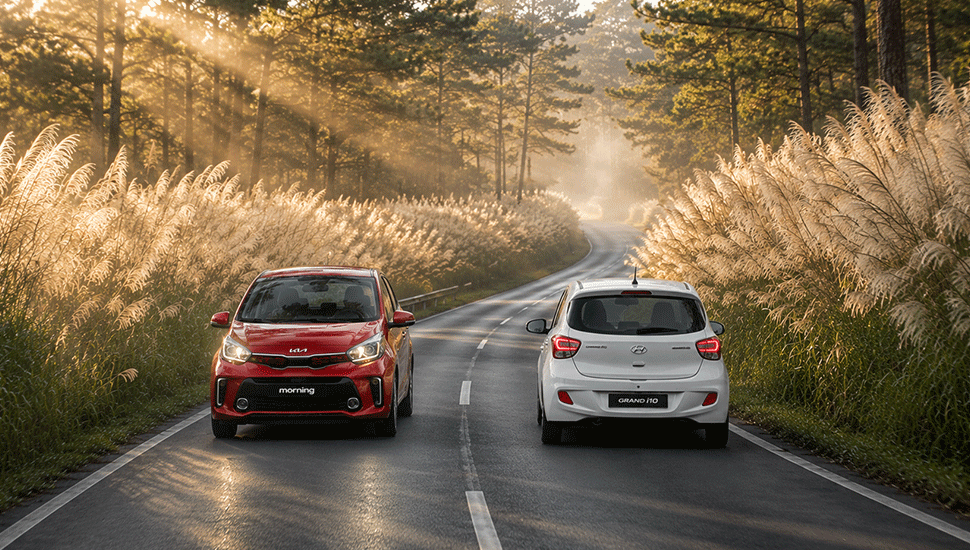
Small cars, under four meters long and with no more than 100 horsepower. They aren’t flashy, and they’re not the stars of dramatic mountain-pass conquests, but they are the quiet lifeblood that sustains the rhythm of city life.
It could be said that in Vietnam, the Daewoo Matiz was the trailblazer of this segment when it appeared in 1998, followed by the Spark and later the Fadil. All of them have since faded away with the shifting market, making way for the younger generation, Kia Morning, Hyundai Grand i10, and Toyota Wigo, to merge onto the fast lane.
When Small Cars Become a Cost Equation for the Masses
In Vietnam, entry-level A-segment cars were once the first gateway that brought millions of families into the world of car ownership. Priced at around 300–400 million VND, the Hyundai Grand i10 or Toyota Wigo used to be the sensible choice for first-time buyers: low purchase cost, light fuel consumption, and cheaper maintenance than higher-riding vehicles.
It was a purely economic equation for a country going through demographic rejuvenation, gradually shifting from motorbikes to cars, where owning your first car mattered far more than how many meters long it was or how many horsepower it had.
But that picture is changing at breakneck speed. Throughout 2025, the entire gasoline-powered A-segment in Vietnam sold just 6,000 units, down more than a third from the year before. That figure, just 6,000 units, is almost unbelievably small compared with the more than 600,000 new cars sold across the whole market.
Even the segment icon, the Grand i10, has seen its sales nearly cut in half. Notably, the crown of the small-car segment no longer belongs to a gasoline model, it has passed to the VinFast VF3, a mini electric car whose sales outstrip all of its gasoline rivals combined.

This shows that the economic value of the “small car” in Vietnam hasn’t disappeared at all, it has simply taken a new form: shifting from a fuel-efficient combustion engine to an electric motor that saves on running costs, backed by incentive policies and a growing charging-station network.
Compared with Vietnam, the popularity of kei-cars in Japan is far more systemic and enduring. Japan’s kei-cars aren’t a passing segment; they’re the product of a tax-and-policy structure that has been consistently designed for more than 50 years.
Kei-cars, with engine displacement capped at 660cc, benefit from significantly lower road tax, weight tax, and insurance premiums than regular-sized cars. In rural areas, kei-car owners aren’t even required to prove they have a fixed parking spot, a privilege that eases the burden of ownership costs.
Thanks to this durable incentive structure, kei-cars still hold a significant share of the market, with total industry sales (including mini vehicles) topping 2.7 million units. Their peak came in 2013, when kei-cars accounted for as much as 40% of Japan’s auto market, and even though the government later raised taxes to push automakers toward “global” models built for export, the segment’s share has stayed at roughly a third of the domestic market for more than a decade since.
The five Japanese automakers that build the most kei-cars are Daihatsu, Honda, Nissan, Suzuki, and Mitsubishi. Rather than developing independently, they share platforms and engines with one another; each brand then adds its own interior and exterior design on top and sets its own pricing.
In Europe, the economic value of small cars follows a different logic: operating costs amid fuel prices and environmental taxes that are among the highest in the world. Models like the Volkswagen Golf, Renault Clio, and Fiat 500 exist as an answer to the sky-high cost per square meter in cities like London, Paris, and Milan, where hourly parking fees can rival the price of a meal. Here, small cars aren’t just cheap to buy, they’re cheap to live with every single day.

The Battle for Urban Space and the Need for Versatility
Viewed through the lens of everyday use, small cars in all three markets share one core advantage: the ability to weave through tightly packed urban spaces. But the degree of “tightness” each place has to deal with is worlds apart, and that shapes how drivers judge a car’s practical value.
In Japanese cities, especially the older residential neighborhoods where alleys are barely wide enough for two cars to pass each other, the maximum kei-car dimensions (no longer than 3,400 mm and no wider than 1,480 mm) are almost a mandatory physical limit for a car to be able to exist there at all.
That’s why the entire kei-car segment is made up exclusively of domestic brands, no foreign automaker has enough incentive to design a dedicated product line just to meet such strict, market-specific standards for a single country.
For the Japanese, a kei-car isn’t just fuel-efficient, it’s a survival tool in the city: easy to park, easy to turn around, easy to squeeze through streets where a B-segment sedan like the Vios would have to “break a sweat” just to maneuver.
Vietnam faces similar operational bottlenecks: narrow alleys, limited parking, and dense mixed traffic full of motorbikes, but it lacks the clear legal framework and usage regulations dedicated to ultra-small cars that Japan has.
As a result, the practical value of small cars in Vietnam is more “defensive” in nature: people choose small cars because of crowded roads and limited apartment-building parking, yet they still expect the car to carry the whole family and handle long trips, versatility demands that go far beyond what a traditional A-segment hatchback like the Kia Morning can deliver.
Over the past decade, high-riding five-seat crossovers have taken the lead: they keep the compactness needed to navigate city streets while also making up for the “not quite enough” feeling of an A-segment car with a higher seating position and a more modern design.
Meanwhile, European road infrastructure, despite plenty of narrow old-town streets, is generally well planned to accommodate both large and small cars. So choosing a small car in Europe is less about being “forced by space,” as in Japan, and more of a lifestyle choice: flexibility for parallel parking on the street, ease of driving in city centers, and, not insignificantly, the minimalist aesthetic typical of Northern and Western Europeans. (Eastern Europe follows a different logic.)
Do Small Cars Still Have a Parking Spot in the Age of Electrification?
In Japan, the kei-car embodies the spirit of “just enough,” a way of life that values restraint, modesty, and avoiding waste. Boxy and somewhat clunky-looking to outsiders, the kei-car is cherished by the Japanese as part of their national industrial identity. The Japanese aren’t embarrassed to drive a small car; on the contrary, it’s seen as a sign of wisdom, knowing exactly what you need and what you don’t.
In Europe, small cars represent personal freedom, expressed through bold, colorful design and a go-all-in spirit. From Britain’s legendary Mini Cooper to Italy’s Fiat 500, small cars in Europe are often personified, blending seamlessly into street fashion.
In Vietnam, however, the cultural story around small cars is somewhat contradictory. On one hand, small cars are tied to the stereotype of “buying your first car,” the smaller, the cheaper. (Try telling that to a Mazda MX-5 owner.) On the other hand, amid rapid urbanization and the spread of highways, incomes still aren’t high enough for a family to own two cars: a Hyundai Grand i10 for grocery runs and a Hyundai Palisade for weekend trips.
Zooming out, small cars in all three markets are facing the defining question of the era: does the combustion engine still have a parking spot as electrification sweeps in? Japan is shifting cautiously with its first electric kei-car models. Europe is accelerating the process under pressure from strict emissions policies. And Vietnam, thanks to a dramatic push from VinFast, appears to be where the transition is happening fastest, as the VF3 has nearly dethroned small gasoline cars entirely within just two years.
Though the paths differ, the destination for small cars remains the same: serving the essential mobility needs of the many, at the most reasonable cost, while leaving the smallest possible environmental footprint.