

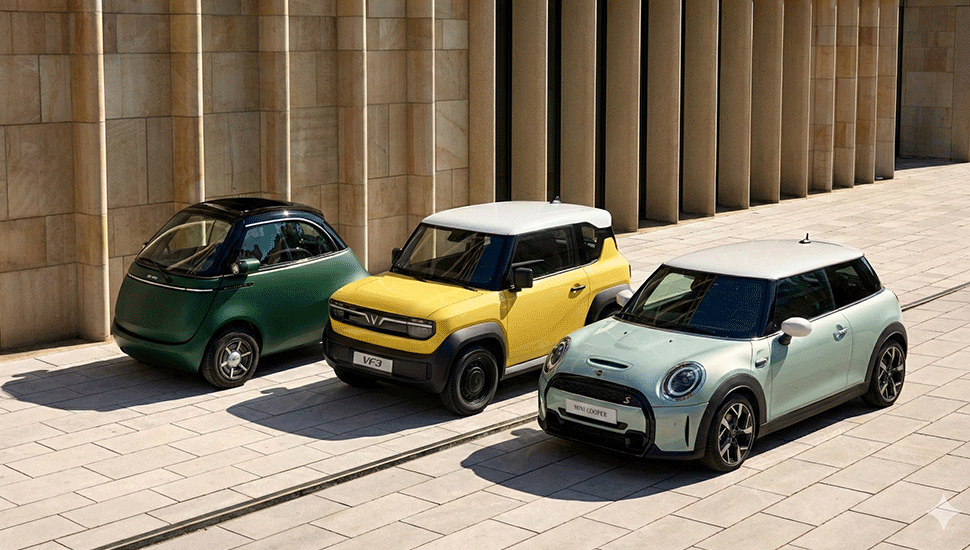
Vietnam, with an urban population density of 314 people per square kilometer and three meter wide alleys that contain an entire universe of daily life—from coffee shops to motorbike repair stalls—should, in theory, be a paradise for microcars. Yet reality says otherwise. Before the arrival of the VF3, this segment was nearly empty: a promised land that no automaker dared to enter.
Perhaps, somewhere deep in our collective subconscious, we still believe that the bigger the car, the higher the status it confers. That a D segment sedan like the Accord is what truly qualifies as a “family car,” while small cars are merely “toys.” That success is measured by how many square meters of steel we occupy on the road, rather than by how intelligently we move.
Could it be that the future of mobility in suffocating cities like Hanoi and Ho Chi Minh City lies in cars with ever longer wheelbases? Let us look back on a 70 year journey of microcars—from the egg shaped Isetta rolling through the streets of Milan to the lime orange VF3 climbing the slopes of Sa Pa—to understand why “small and compact” might be the answer to a question we have not yet learned to ask.
Prelude: the egg that rolled through Milan
In 1953, on the war scarred streets of Milan, a strange little vehicle appeared, as if it had stepped straight out of a fairy tale. The Isetta—an egg shaped car with a front opening door that invited you into another world. At just 2.29 meters long and a mere 1.37 meters wide, it was not a car in the traditional sense. It was a declaration: in a resource starved postwar world, driving did not need to be powerful like artillery.
Iso Rivolta, an Italian refrigerator manufacturer, understood that people needed mobility—but not machines built like cannons.
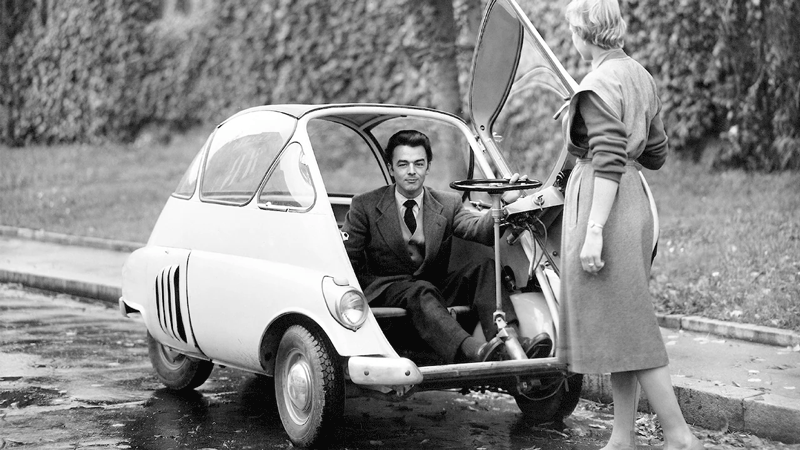
BMW seized the opportunity and purchased the Isetta license. From 1955 to 1962, the German automaker upgraded the Isetta to 13 horsepower, converted it to four wheels, added a sunroof, refined the suspension, and in the process turned the Italian egg into a global phenomenon—selling more than 160,000 units before ending production.
Chapter One: the British Mini
Alec Issigonis, the brilliant British engineer of Greek origin, sketched the first Mini concept on a restaurant napkin. At 3.05 meters long, the Mini was shorter than today’s VF3, yet astonishingly, 80% of its length was devoted to passenger space. Issigonis mounted the engine transversely and pushed the wheels out to the four corners like a chessboard. The natural rubber suspension was both economical and delivered an uncanny sense of road grip.
But what turned the Mini into a legend was not its design. In 1964, John Cooper—the Formula racing car builder—recognized the potential of that tiny chassis. He installed a 997cc engine (later 1275cc), upgraded the brakes to discs, and added racing stripes on the roof. The Mini Cooper S was not born to go grocery shopping. It was born to win.

And win it did.
Monte Carlo Rally 1964, 1965, 1967—three victories against Porsches and Ford Mustangs twice its size. Drivers described piloting the Mini as “controlling a fly armed with a machine gun”—absurdly nimble, gripping the road as if magnets were hidden beneath its floor.
In 1960s London, The Beatles drove Minis to recording sessions. Mary Quant—the designer of the miniskirt—drove a Mini too. Princess Margaret, Peter Sellers, Steve McQueen—all kept a Mini in their garages alongside Rolls Royces and Aston Martins. Because a Mini didn’t say whether you were rich or poor. It said whether you had style.
BMW acquired Mini in 2000 and did what many thought impossible: preserve the soul within a modern body. The new generation Mini Cooper grew to 3.8 meters—no longer “micro” by technical standards, yet unmistakably Mini in its DNA. Turbocharged engines, sporty suspension, electric steering… In other words, Mini was refined over time while retaining its mischievous spirit.
When you sit inside, shut the door with that solid thunk, and look at the oversized circular gauge in the center of the dashboard, you still feel like you’re driving a car from 1959. Some critics claim the modern Mini Cooper has “betrayed” the small car philosophy. They forget that Mini was never about size. It was about a car that makes you grin every time you turn the key, press the accelerator, and sweep through an inviting corner. “Mini” is a state of mind, not a number in a catalog.
Chapter Two: Japan’s Kei Car
The Japanese looked at the Isetta not with the eyes of imitators, but with the mindset of artisans. In the late 1960s, as Japanese traffic laws imposed strict vehicle registration quotas, they created the kei car category—and, with it, an entirely new car culture.
Kei car regulations read like a mechanical haiku: no more than 3.4 meters long, 1.48 meters wide, and an engine not exceeding 660cc. Within these tight constraints, Japanese engineers worked miracles. The Honda N Box with its soaring cabin, the Suzuki Jimny with astonishing off road ability, the Daihatsu Copen as a sporty convertible—all were born from the same limited framework.
After more than half a century on the road, kei cars have become an expression of the Japanese concept of ma—meaningful empty space. A Suzuki Ignis fitting perfectly into a Tokyo alley is not small for the sake of being small, but designed to merge seamlessly into urban life like the final piece of a puzzle.
Chapter Three: The Wuling Mini EV
In 2020, amid the pandemic and the explosive rise of China’s EV industry, an unlikely name rose to the top: the Wuling Mini EV. Boxy like a cardboard carton, with an interior as cramped as a subway car at rush hour, it nevertheless sold 426,000 units in its first year—outselling the Tesla Model 3 in China.
The Wuling Mini became the school run shuttle, the market hauler, the nimble navigator of multilayered urban alleys. A range of 120–170 km was hardly a drawback when 90% of urban users travel less than 50 km per day.
What surprised everyone was how deeply the Wuling resonated with young people. They customized their cars with cartoon decals, colorful LED lights, turning the little box into a “mobile office” and a cultural phenomenon—not merely a consumer product.
Chapter Four: The VinFast VF3
In May 2024, the VinFast VF3 debuted at a price of 235 million VND (without battery) or 300 million VND (with battery)—a level many young Vietnamese families could afford outright without years of installments.
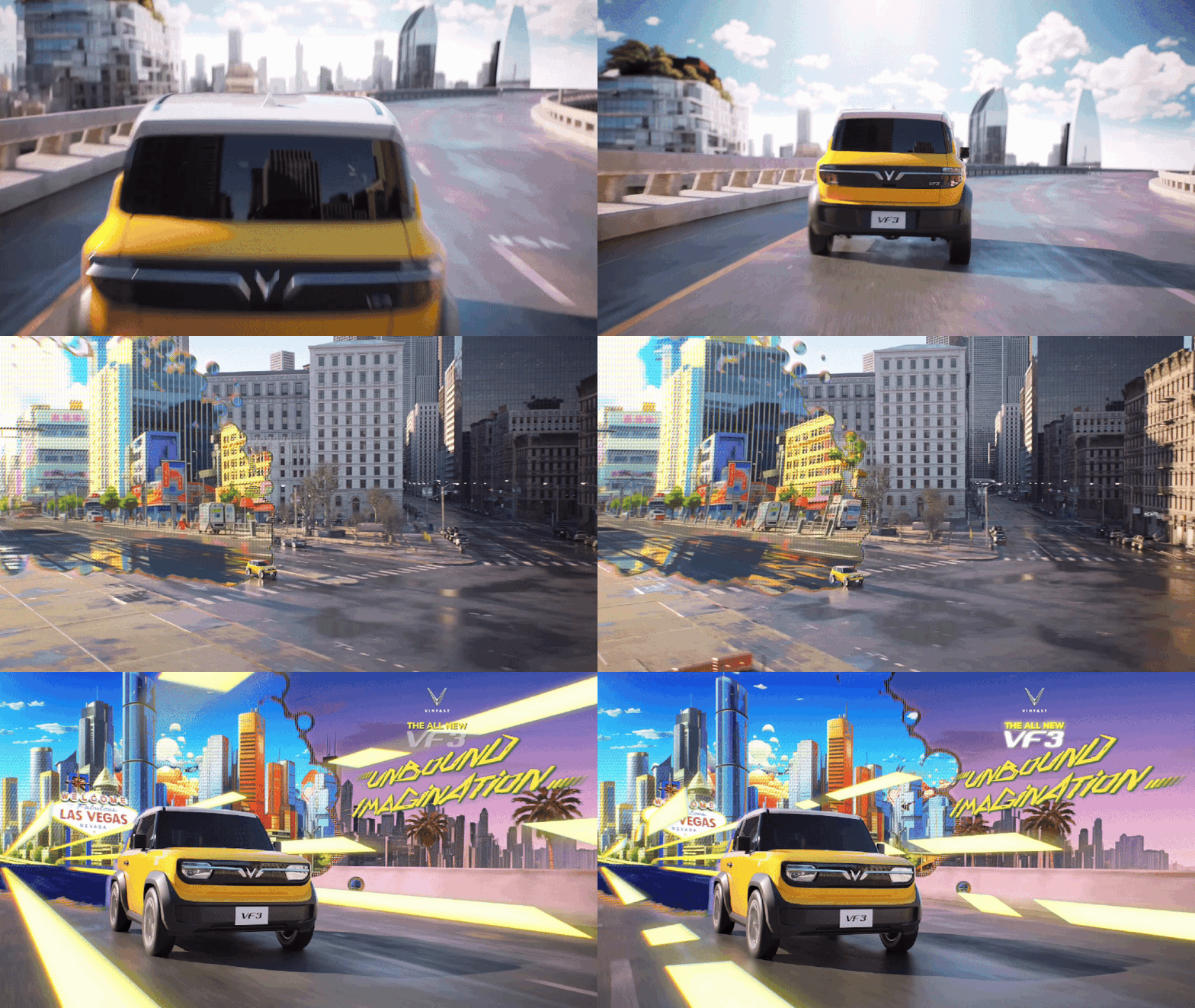
Seeing the VF3 on the road for the first time, it is easy to be charmed by its gift box like design, as if it’s waiting to be unwrapped. Measuring 3.19 meters long and 1.68 meters tall, the VF3 fits perfectly within urban kei car proportions. Its face stands out with round, non LED headlights like wide open eyes eager to explore the world. A horizontal trim line stretches across the front like a playful sculpted eyebrow, while the V shaped logo in the center resembles a decorative bow. From afar or up close, the VF3 is simply adorable.
It is big enough to be considered a “real car” in the Vietnamese mindset, yet small enough to slip through alleys barely three meters wide. What truly made the VF3 successful, however, was not technology but timing. Right moment, right price, right attitude—three words that summarize VinFast’s strategy.
That “attitude” is not just about bright colors. It is the pride of driving a “Made in Vietnam” car, enjoying free parking and charging at many shopping malls, and belonging to a community of over 50,000 owners eager to share modification tips in Facebook groups.

Interestingly, whether drivers are 20 or 50 years old, everyone seems to look—and be told they look—a few years younger behind the VF3’s steering wheel. One bank department head shared: “My colleagues say that since I started driving the VF3, I smile a lot more. Maybe it’s because every time I look down at the parking lot and see it wriggling among a sea of cars—like a colorful candy among black and white chocolate bars—I just can’t help but laugh.”
Epilogue: Microlino, the European microcar
In 2016, the Ouboter brothers—the minds behind the world famous Micro Scooter—decided to do something crazy: revive the Isetta using electric technology.
At just 2.5 meters long and weighing a feather light 496 kg, the Microlino comfortably seats two people and offers 230 liters of cargo space—enough for a weekend trip to Lake Geneva. Its front opening door echoes the original Isetta, but now comes with electronic locks, LED lights, and a touchscreen display. Top speed is 90 km/h, range reaches 228 km, and a full charge takes four hours from a standard outlet.
Equally fascinating is the production philosophy. Micro Mobility owns no factory of its own; instead, it partners with Italy’s Cecomp for manufacturing and assembly. Swiss precision meets German engineering, crafted on Italian soil—a miniature European symphony.
Most intriguing of all is what 20 years of making children’s scooters taught them: vehicles must be absolutely safe, exceptionally durable, and intuitive enough to need no manual. These principles were applied wholesale to the Microlino. A rigid unibody frame, suspension tuned to glide smoothly over gravel, and controls as simple as a video game.
Closing words: is the market big enough for microcars?
From the Isetta in 1953 to the Microlino in 2023, this 70 year story delivers a single truth: the future of cities does not lie in ever larger SUVs, but in the wisdom of downsizing.
Japanese kei cars teach us that limitations can inspire creativity. The VF3 shows how a developing market can leapfrog internal combustion and step straight into the electric era. The Microlino reminds us that heritage is not meant to be preserved unchanged, but reborn.
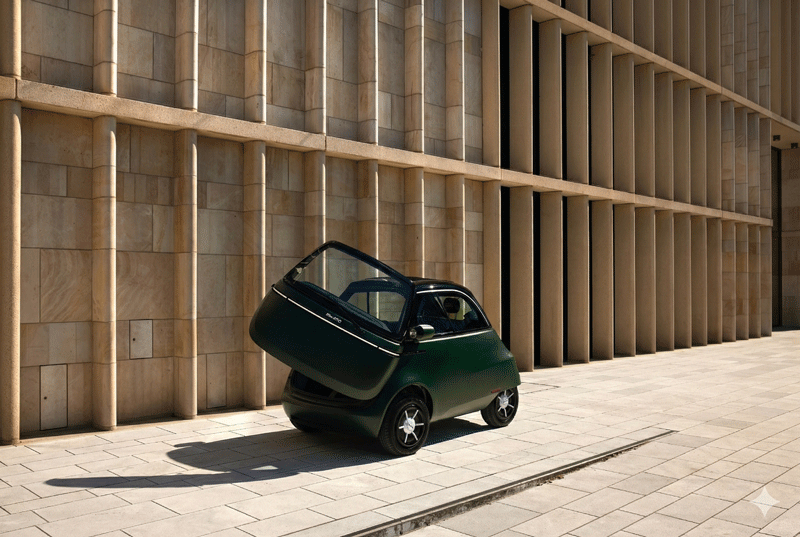
As Asian cities choke on congestion and pollution, European centers close their doors to combustion engines, and younger generations worldwide seek sustainable lifestyles, microcars are no longer a secondary option. They are the answer.
And within that answer echoes the sound of the very first Isetta, rolling through the streets of Milan all those years ago.