


In the automotive industry, if you want to understand who is winning, don’t look at the most beautiful car at the launch event, don’t look at the list of slow-selling cars for the month; look instead at the cold, hard sales numbers in the three biggest markets on the planet. China, the United States, and the countries of Europe remain the three battlegrounds that decide the fate of every automotive group.
Toyota still sits at the top with 11 percent market share, no surprise there. But right behind it is a dramatic race between familiar European names and new forces, with three Chinese automakers appearing in the top 10 largest automotive manufacturing groups in the world for the first time. Among those ten names, three stories are worth easing off the throttle for and lingering over a little longer.
Volkswagen: second in the world, 8.1 percent market share
If you had to pick one name to represent the spirit of German industry, none would fit better than Volkswagen, “the people’s car,” born in 1930 and forever tied to the rounded little Beetle, which once carried an entire postwar generation through rubble-strewn streets in search of a return to ordinary life.
Nearly a century later, Volkswagen has grown far beyond being a mere carmaker, swelling into an industrial empire that stretches from budget hatchbacks all the way to million-dollar supercars.
Under the Volkswagen Group banner sits an astonishing portfolio of brands: mainstream Volkswagen, luxurious Audi, practical Eastern European style Škoda, youthful Spanish SEAT/Cupra, speed-obsessed Porsche, plus the supercar trio of Lamborghini, Bentley, and Bugatti. It is an ecosystem whose depth across segments few automotive groups in the world can match.

But the empire is entering a testing phase. With 8.1 percent of global market share in the first half of 2026, Volkswagen still holds on to second place, yet the gap with Toyota keeps widening rather than closing, showing that Toyota has pulled well ahead of Volkswagen.
The reason lies in what has been Volkswagen’s “second home turf” for two decades: China. The figures show that Volkswagen delivered only around 973,000 vehicles in the Chinese market during the first six months of the year, down 26 percent compared with the same period last year.
That is a painful slowdown playing out exactly as expected, reflecting how Chinese consumers are no longer infatuated with foreign brands and have started opening their wallets for homegrown Chinese models that are cheaper, better looking, and packed with more technology.
Volkswagen now faces a puzzle that is not easy to solve: keep clinging to the Chinese market and wait for an eastern wind to turn things around, or plan a rapid shift toward Southeast Asian countries to reverse its position in the rankings? According to data from Suốt Ngày XE’s Agent AI, the second scenario looks more promising.

Two Volkswagen models that have sold well in Vietnam over the past three years: the Viloran MPV and the Teramont SUV.
Stellantis: fourth in the world, 6 percent market share
If Volkswagen represents the continuous flow of German history, Stellantis carries a completely different flavor, a story of cross-continental mergers and acquisitions. Born in 2021 from the stunning handshake between Fiat Chrysler Automobiles (Italy and the United States) and PSA Group (France), Stellantis has one of the most complicated family trees in the automotive industry:
- Peugeot and Citroën from France
- Fiat, Alfa Romeo, and Maserati from Italy
- Opel/Vauxhall from Germany and Britain
- Jeep, Ram, Chrysler, and Dodge from the United States
Fourteen brands, four countries, dozens of different driving cultures, all packed into a single group. With 6 percent of global market share, Stellantis holds fourth place in the rankings, a figure that reflects the strength of its “multinational, multi-brand, multi-market” strategy.
- Jeep dominates the off-road SUV segment in the United States
- Peugeot and Citroën hold firm in Europe
- Fiat remains a cultural icon in its home country of Italy
But this sheer size is a double-edged sword, a management nightmare. Managing fourteen brands means having to balance the individual identity of each name and each market against the need to optimize costs and share technical platforms.
With both the American and European markets stalling, the wave of Chinese electric vehicles is now flooding into South America and Southeast Asia, markets that used to be Stellantis’s traditional backyard, so the group’s challenge today is no longer just selling cars but keeping its enormous brand alliance from fragmenting during this technological transition. It’s a real headache.
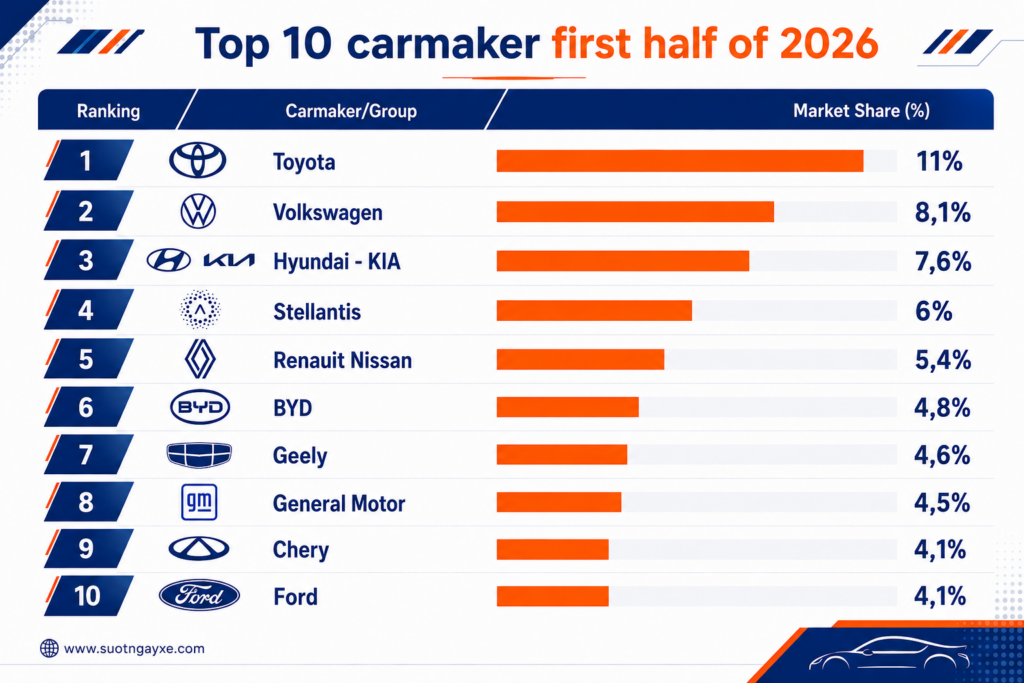
Geely: seventh in the world, 4.6 percent market share
Geely, a young automaker with outsized ambition (founded in 1986), officially began building cars on August 8, 1998, when it launched the Geely Haoqing, built on a Daihatsu platform with a Toyota engine, and is now using speed and technology to leapfrog decades of accumulated experience held by its Western rivals.
With 4.6 percent market share, what stands out is not really the number but the way Geely has planted its flag. Under Geely Holding sits a matrix of brands spanning from mass market to premium: Geely Auto serves the broad public, Lynk & Co targets young urban buyers, Zeekr covers the premium electric vehicle segment, alongside four international brands: Volvo from Sweden and Lotus from Britain, high performance electric vehicle startup Polestar, and Malaysia-origin Proton.
What gives Geely its strength lies in the layer of technology hidden behind those names. The group has built a network of research and development centers across countries such as China, Sweden, Germany, and Britain, where thousands of engineers are developing electric vehicle technology, artificial intelligence, and smart driving systems, while also owning a large scale safety testing center in Ningbo, considered the largest safety certification center in the world with an investment of hundreds of millions of dollars.
Geely also owns four important platform architectures used to replicate vehicles across all of the group’s shared brands, and this is the core asset that has helped Geely grow at lightning speed, and keep accelerating even further.
1/ CMA Architecture
As the first basic modular architecture designed for the B segment, CMA has been widely applied across brands such as Lynk & Co, Geely, Volvo, and Polestar, with nearly 20 models developed on it and cumulative global sales exceeding 1.2 million units.
2/ BMA Architecture
A compact modular platform developed independently by Geely, meeting strict European safety standards. With its high flexibility, BMA works across many vehicle types, from SUVs, sedans, and crossovers to wagons and even MPVs, meeting the market’s diverse needs.
3/ SPA Architecture
The latest breakthrough achievement, SPA harmoniously combines premium hardware with advanced digital technology, carrying Geely into the era of hybrid electric vehicles (HEV) and smart technology, and opening the door to a future of upscale driving experiences.

4/ SEA Architecture
The result of four years of intensive research and development dedicated entirely to electric vehicles, SEA offers some of the most flexible scalability in the world, suited to vehicle segments ranging from A to E, including sedans, SUVs, MPVs, and pickup trucks.
Beyond the trio of Geely models already being well received in the Vietnamese market, Geely and its powerful local partner Tasco Auto have introduced a full lineup of brands, with a rich variety of body styles and a wide range of drivetrains.
- Geely Coolray: a mainstream car priced around 500 million dong
- Geely EX5 PHEV: a hybrid priced around 900 million dong
- Volvo EC40: a pure electric vehicle priced around 1.7 billion dong
- Lynk & Co 900: an executive PHEV priced above 3 billion dong
- Lotus Eletre: a performance electric vehicle priced above 4 billion dong
An eastern wind named Geely is now blowing strongly across Vietnam’s automotive landscape, aided by government tax and fee support for hybrid and electric vehicles through the end of 2030.
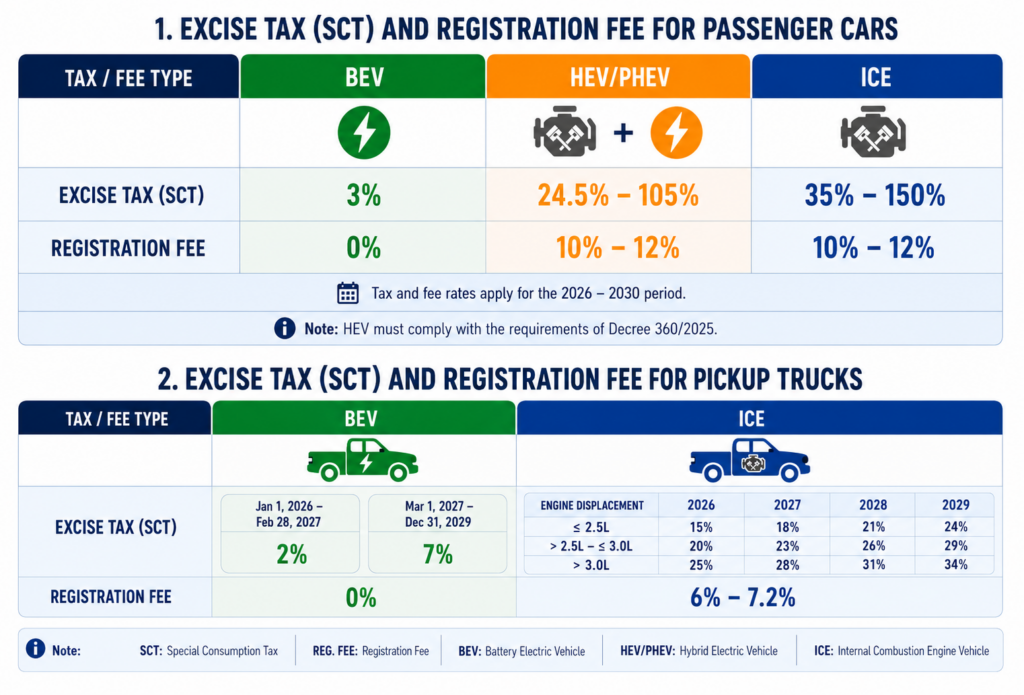
Vietnam’s EV market continues to be dominated by homegrown automaker VinFast, the country’s market leader. Over the past three years, the brand has consistently accounted for around 95% of all electric vehicle sales across every segment, leaving its closest rival, BYD, far behind.